

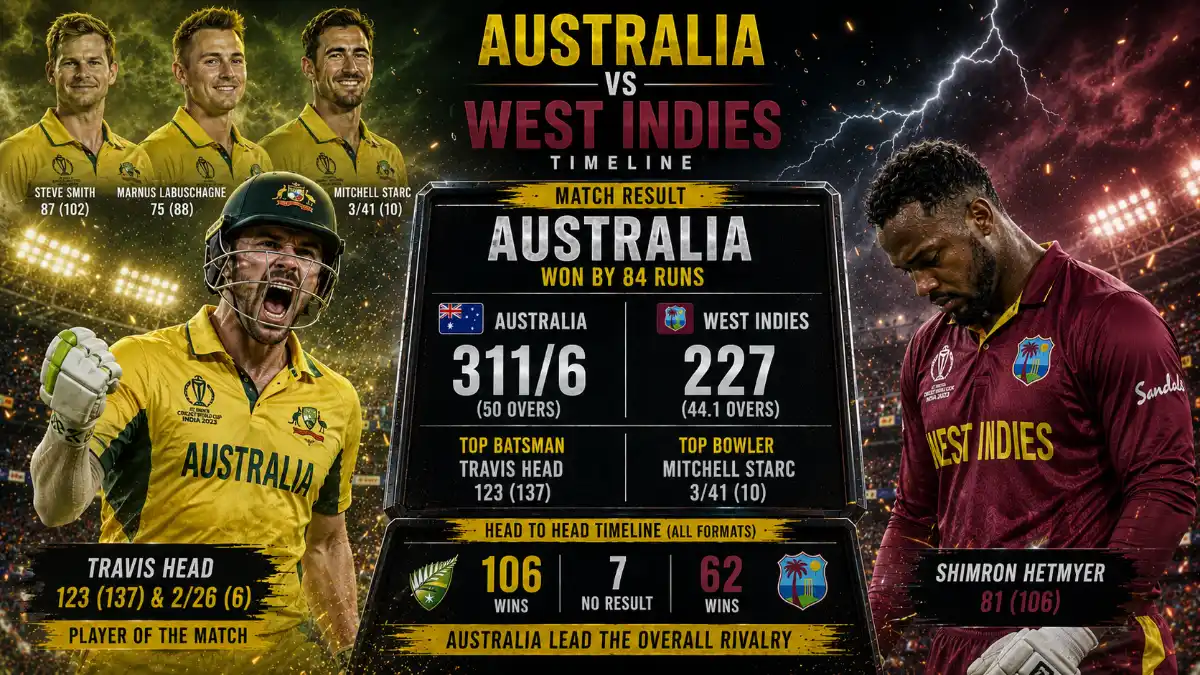
Australia leads the head-to-head battle against West Indies 64 wins to 33 across 123 Test matches since 1930, though the rivalry’s most dramatic modern chapter came in January 2024, when West Indies stunned Australia at the Gabba to end a 20-year Test win drought. This comprehensive Australian men’s cricket team vs West Indies cricket team timeline traces nearly a century of cricketing history – from the West Indies’ fearsome pace era of the 1980s to Australia’s modern-day dominance and the shock upsets that keep this fixture relevant even in 2026.
Cricket fans searching for the full story behind this rivalry usually want three things: who’s winning right now, what happened historically, and why certain matches still get talked about years later. This guide answers all three, with context behind every major swing in momentum.
Head-to-Head Snapshot: Who Leads the Rivalry
Australia holds a commanding lead in the all-time Test record against West Indies, having won 64 of 123 matches compared to West Indies’ 33 victories, with 26 draws and one famous tie. This head-to-head split is the foundation of the entire Australian men’s cricket team vs. West Indies cricket team timeline, and it tells only half the story – because the split looks very different depending on which decade you examine.
| Format | Total Matches | Australia Wins | West Indies Wins | Draws/Tied |
| Test Matches | 123 | 64 | 33 | 26 (1 tied) |
| All International Formats | 251 | – | – | – |
The tied Test is worth noting on its own – it happened at the Gabba in December 1960 and remains one of only two tied matches in the entire history of Test cricket, a genuine rarity that still gets referenced whenever cricket historians discuss the format’s dramatic ceiling.
Why the Numbers Don’t Tell the Full Story
Raw win-loss totals flatten decades of shifting power. West Indies were the dominant force in world cricket through the 1980s and early 1990s, while Australia has controlled this fixture almost completely since the mid-1990s. Reading the numbers in isolation misses the tactical and generational shifts that actually explain them.
Origins of the Rivalry: 1930 to 1978
The Australia-West Indies Test rivalry began in December 1930, with Australia winning the inaugural five-match series 4-1 on home soil. For nearly five decades after that first series, Australia held the clear upper hand, and West Indies didn’t manage to win an entire series against them until the 1977/78 tour of the Caribbean.
Early Australian Control
Australia’s dominance in this period wasn’t accidental – it reflected a broader gap in resources, structured domestic cricket, and player depth. Series wins in 1930/31 (4-1), 1951/52 (4-1), and 1975/76 (5-1) all went comfortably in Australia’s favor, with the Australians relying on strong seam bowling and disciplined top-order batting to grind down West Indian resistance.
Read More: Australian Men’s Cricket Team vs West Indies Cricket Team Timeline
The First West Indies Breakthrough
West Indies finally turned the tide in 1977/78, winning a home series 3-1 against Australia. This series is historically significant because it marked the first real signs of the fast-bowling philosophy West Indies would later perfect – a template built around sustained pace pressure rather than variety or spin.
The West Indies Golden Era: 1979 to 1995
West Indies dominated Australia almost completely between 1979 and 1995, winning six consecutive Test matches during their fearsome 1984 tour and claiming series victory after series victory throughout this period. This stretch is widely regarded as the peak of West Indian fast bowling in world cricket, and Australia simply had no consistent answer.
The Pace Battery That Changed Everything
The 1980s West Indies attack relied on a four-pronged fast-bowling rotation that gave batsmen no rest across an entire innings, let alone a full session. Unlike traditional attacks built around a single strike bowler, West Indies used continuous hostile pace from both ends, wearing down opposition batting line-ups through sheer physical and psychological pressure rather than trickery.
Series wins in 1979/80, 1983/84, 1984/85, 1990/91, and 1992/93 all went the Caribbean side’s way, several of them by convincing margins. Australia’s best batsmen of the era – including several future Hall-of-Famers – regularly described facing this attack as the most physically demanding challenge in world cricket.
Why This Era Still Matters Today
Every modern discussion of fast-bowling strategy in Test cricket references this period as the benchmark. Sustained aggression, rotating pace threats, and relentless bouncer tactics born in this era still influence how teams – including today’s Australian attack – plan their bowling strategies against top-order batsmen.
Australia’s Era of Total Control: 1996 to 2016
Australia reversed the power balance decisively from the mid-1990s onward, winning every single Test series against West Indies for two full decades, including a 5-0 whitewash in 2000/01. This two-decade stretch represents the longest period of one-sided dominance in the entire Australian men’s cricket team vs West Indies cricket team timeline.
The Structural Collapse Behind the Numbers
This wasn’t purely a talent gap in any single series – it reflected deep structural decline in West Indian cricket administration, domestic pathways, and player retention, occurring at the exact moment Australia was producing arguably its greatest generation of cricketers. The result was a mismatch that widened with every passing series.
Key Series of Australian Dominance
Series victories in 1996/97 (3-2), 2000/01 (5-0), 2005/06, 2009/10, 2012, 2015, and 2015/16 all went Australia’s way without exception. West Indies’ last Test win against Australia during this entire stretch came in Antigua in May 2003 – a drought that would eventually stretch to two decades before it was broken.
What Changed for the West Indies
Talent didn’t disappear from West Indies cricket during this period, but the structures that once converted individual brilliance into consistent Test success had. Players moved toward Twenty20 leagues for financial security, board instability disrupted team continuity, and the pace pipeline that once terrorized batting line-ups thinned considerably.
The Gabba Shock: Breaking a 20-Year Drought
West Indies ended their 20-year Test win drought against Australia by winning the second Test at the Gabba by 8 runs in January 2024, immediately after Australia had won the series opener in Adelaide by 10 wickets. This result stands as the single most significant upset in the modern chapter of this rivalry.
How the Series Unfolded
Australia won the first Test in Adelaide (January 17-19, 2024) comfortably by 10 wickets, setting up an expectation of another routine series sweep. West Indies had other plans in the second Test at the Gabba (January 25-28, 2024), where disciplined bowling and gritty batting under pressure produced an 8-run victory that shocked the cricketing world.
Why the Gabba Result Mattered So Much
This wasn’t just a single match win – it was proof that West Indies still possessed the bowling talent to disrupt a top-tier Test side on hostile territory, despite two decades of broader decline. For a team ranked near the bottom of the world Test rankings at the time, beating Australia in Australia carried enormous psychological and reputational value heading into future contests.
Post-Gabba Response: Australia Reasserts Dominance
Australia responded emphatically to the Gabba upset by winning consecutive away series against West Indies 3-0 in both the 2024/25 season and again in 2025, snuffing out any sustained momentum from the earlier shock. These results confirmed that Australia’s overall squad depth remains the deciding factor across a full series, even when individual matches can go against them.
The 2024/25 Caribbean Tour
Touring the Caribbean immediately after the Gabba defeat, Australia produced a dominant response, sweeping the return series 3-0 and demonstrating the kind of squad depth that West Indies currently cannot match across five-day cricket.
The 2025 Series Repeat
Australia repeated the same 3-0 result in their most recent Caribbean tour in 2025, extending their recent stranglehold on the fixture despite the earlier Gabba hiccup. This back-to-back series dominance underlines just how difficult it remains for West Indies to sustain competitive form across multiple Tests, even when they’re capable of producing a single standout performance.
White-Ball Form Follows a Similar Pattern
Australia’s recent limited-overs form in the Caribbean has mirrored their Test dominance, with strong wins in recent ODI meetings underscoring the gap in overall squad strength across formats, not just the longer form of the game.
Complete Series-by-Series Results Timeline
| Season | Host Nation | Series Result | Winner |
| 1930/31 | Australia | 4-1 | Australia |
| 1951/52 | Australia | 4-1 | Australia |
| 1960/61 | Australia | 2-1 (incl. Tied Test) | Australia |
| 1964/65 | West Indies | 2-1 | West Indies |
| 1975/76 | Australia | 5-1 | Australia |
| 1977/78 | West Indies | 3-1 | West Indies |
| 1979/80 | Australia | 2-0 | West Indies |
| 1983/84 | West Indies | 3-0 | West Indies |
| 1984/85 | Australia | 3-1 | West Indies |
| 1990/91 | West Indies | 2-1 | West Indies |
| 1996/97 | Australia | 3-2 | Australia |
| 2000/01 | Australia | 5-0 | Australia |
| 2015/16 | Australia | 2-0 | Australia |
| 2023/24 | Australia | 1-1 (incl. Gabba upset) | Drawn |
| 2024/25 | West Indies | 3-0 | Australia |
| 2025 | West Indies | 3-0 | Australia |
This table represents the core skeleton of the Australian men’s cricket team vs West Indies cricket team timeline and shows clearly how momentum has swung twice across nearly a century – once toward West Indies in the 1980s, and decisively back toward Australia from the mid-1990s onward.
Key Tactical Themes Across the Rivalry
Three tactical patterns define this rivalry across every era: sustained fast-bowling pressure, top-order batting depth, and squad continuity – and whichever side has held an advantage in these three areas has typically won the era, not just the match. Understanding these patterns helps explain both the historical dominance swings and the more unpredictable modern results.
Fast Bowling as the Deciding Factor
Every major shift in this rivalry traces back to bowling depth. West Indies’ four-pronged pace attack in the 1980s overwhelmed Australia through sheer volume of hostile bowling, while Australia’s own world-class pace and spin combinations from the late 1990s onward reversed that exact dynamic.
Batting Depth Under Pressure
Series results across this rivalry have consistently hinged on which team’s middle order could absorb sustained bowling pressure without collapsing. The Gabba Test in 2024 stands out precisely because West Indies’ lower-middle order held firm in a low-scoring, high-pressure finish that could easily have gone the other way.
Squad Depth Across a Full Series
Single-match upsets happen in every rivalry, but full series wins require squad depth across all conditions, and this is where Australia’s advantage has been most consistent since the mid-1990s. The immediate 3-0 responses following the 2024 Gabba shock reinforced this exact point.
What This Rivalry Reveals About Modern Test Cricket
The Australian men’s cricket team vs West Indies cricket team timeline offers a useful case study in how cricketing power shifts over generations rather than single seasons. West Indies’ current position – capable of producing standout individual performances but struggling for consistency across full series – reflects broader challenges facing the format outside the traditional “big three” cricketing nations.
For Australia, maintaining dominance across formats and conditions against a resurgent West Indies bowling unit remains an ongoing test of squad management, particularly as fast bowlers on both sides face increasing workload pressure from global T20 leagues competing for their availability.
Frequently Asked Questions
How many Test matches have Australia and the West Indies played against each other?
Australia and the West Indies have faced off in 123 Test matches, making this one of the most historically significant fixtures in the sport.
Who leads the head-to-head Test record between Australia and the West Indies?
Australia leads comfortably with 64 wins compared to West Indies’ 33, alongside 26 draws and one tied match.
When did Australia and the West Indies play their first Test series?
The rivalry began in December 1930, when Australia won the opening five-match series 4-1 on home soil.
Which era did the West Indies dominate in this rivalry?
West Indies controlled the fixture from 1979 through the early 1990s, highlighted by six consecutive Test wins during their 1984 tour of Australia.
What was the biggest recent shock result in this rivalry?
West Indies beat Australia by 8 runs at the Gabba in January 2024, ending a 20-year Test win drought against the Australians.
When did the West Indies last beat Australia before the 2024 Gabba Test?
Their previous Test win over Australia had come in Antigua back in May 2003, more than two decades earlier.
Has there ever been a tied Test between these two teams?
Yes, the sides played out a tied Test at the Gabba in December 1960, one of only two tied matches in Test cricket history.
How did Australia respond after losing the 2024 Gabba Test?
Australia won their following two series against West Indies by identical 3-0 margins in 2024/25 and again in 2025.
Which series marked the peak of Australian dominance in this rivalry?
The two-decade stretch from 1996 to 2016 saw Australia win every single series against West Indies without exception, including a 5-0 whitewash in 2000/01.
Have Australia and the West Indies met across all cricket formats, not just Tests?
Yes, including Tests, ODIs, and T20Is, the two nations have played 251 international matches against each other in total.