

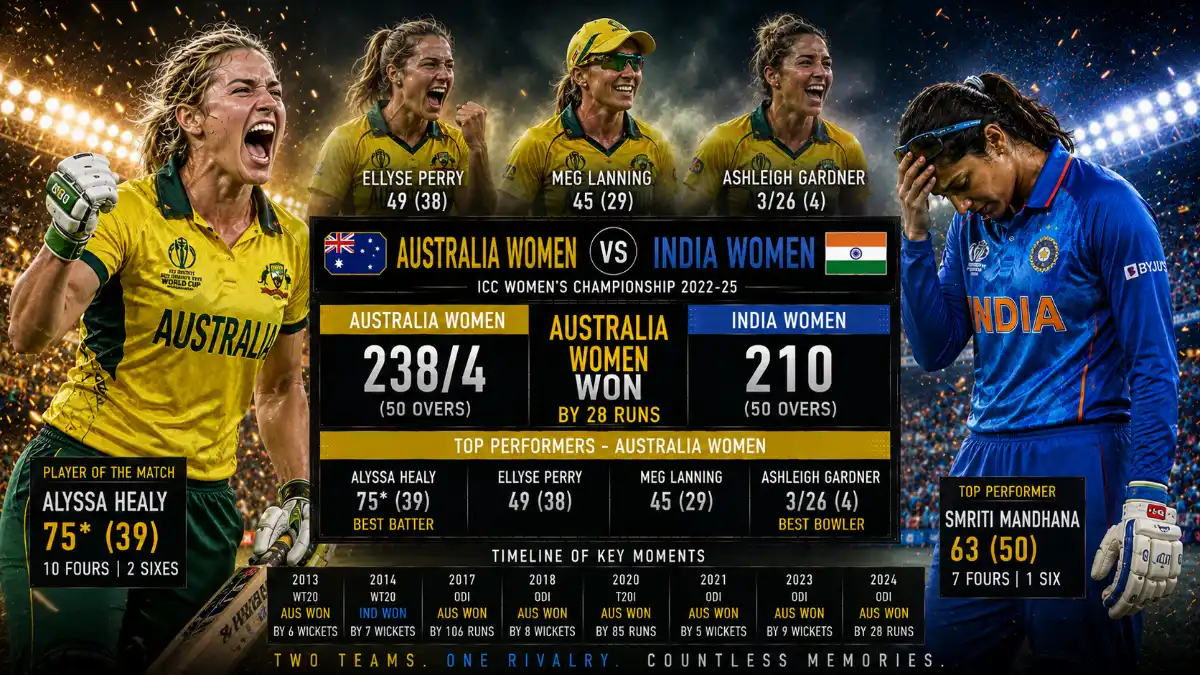
Across the 2025-26 season, Australia beat India Women 3-0 in ODIs, 1-0 in the one-off Test, and 1-0 in their T20 World Cup 2026 group-stage meeting – a clean sweep that reshaped the balance of power in the Australia women’s national cricket team vs India women timeline.
This isn’t just a string of results. It’s a case study in how depth, composure, and home conditions compound into a rivalry advantage that keeps widening every season. Below is the full breakdown – match by match, session by session – of how Australia turned a competitive fixture list into a statement of supremacy.
Why This Rivalry Now Defines Women’s Cricket
The Australia-India women’s rivalry has become the sport’s most closely watched contest because both teams entered 2026 as genuine title contenders across all three formats, making every fixture a barometer of global standing.
India walked into the 2025-26 tour of Australia as reigning 50-over World Cup champions, chasing something they’d never fully cracked – consistent away form on Australian soil. Australia, meanwhile, treated the series as both a title defense and a farewell tour, with Alyssa Healy playing out her final months as captain across formats. That dual narrative – a champion chasing legitimacy, a dynasty closing a chapter – gave every match in this Australia women’s national cricket team vs India women timeline unusual emotional and competitive weight.
The Stakes Behind the Numbers
Bilateral cricket between these two sides now directly feeds into ICC Women’s Championship points, meaning results carry World Cup qualification consequences, not just bragging rights. Every ODI in this series doubled as a championship-table battle, which explains why Australia’s batting lineup attacked with such intent from ball one rather than easing into totals. For India, a poor showing risked derailing qualification math for the next 50-over cycle – a pressure that showed up in some uncharacteristically defensive middle-over batting.
The 2025-26 ODI Series: Australia’s Ruthless Sweep
Australia swept India 3-0 in the ODI leg of the series, winning by 6 wickets in Brisbane, 5 wickets in Hobart, and then by a crushing 185 runs in the series decider – never trailing the head-to-head count at any stage.
Match 1: Brisbane Sets the Tone
The series opener at Allan Border Field, Brisbane, immediately exposed the gap Australia would exploit all series. India posted a respectable 214, built on fifties from Smriti Mandhana (58) and captain Harmanpreet Kaur (53), but the total lacked the finishing punch needed against a deep Australian batting order. Ashleigh Gardner’s disciplined spell of 3 for 33 broke India’s middle order at exactly the moment it needed stability, removing Jemimah Rodrigues, Harmanpreet, and Kranti Gaud in quick succession.
Australia’s reply showed why they’ve become nearly untouchable on home turf. Beth Mooney’s unbeaten 76 anchored two crucial partnerships – a 64-run stand with Alyssa Healy and an 85-run alliance with Annabel Sutherland – carrying the hosts home with 11 overs still in hand. India’s bowling attack offered little resistance beyond Shree Charani’s 2 for 41, a pattern of thin support bowling that would resurface throughout the tour.
Match 2: Hobart Turns Into a Batting Carnival
The second ODI, also played at a day-night slot in Hobart, became a showcase for Australia’s batting depth rather than a genuine contest. India’s total of 251 for 9 initially looked competitive, but Georgia Voll’s blistering 101 off 82 balls, supported by Courtney Litchfield’s 80 off 62, turned the chase into a formality. Australia wrapped up victory with 83 balls unused, sealing the ODI series with a match remaining – a psychological blow that visibly affected India’s body language heading into the decider.
Match 3: Healy’s Farewell Statement
By the third ODI at Bellerive Oval, Australia stopped chasing games and started making statements. Playing out her farewell ODI series as captain, Alyssa Healy smashed 158 off just 98 balls, propelling Australia to a mammoth 409 for 7. India’s reply folded for 224, completing a 185-run demolition and a spotless 3-0 sweep of the ODI leg. It was the kind of individual innings that instantly enters series highlight reels and record conversations.
ODI Series Snapshot
| Match | Venue | Result |
| 1st ODI | Allan Border Field, Brisbane | Australia won by 6 wickets |
| 2nd ODI | Bellerive Oval, Hobart | Australia won by 5 wickets |
| 3rd ODI | Bellerive Oval, Hobart | Australia won by 185 runs |
Read More: Australia Women’s National Cricket Team vs India Women Timeline
The Pink-Ball Test: Sutherland’s Career-Defining Innings
Australia crushed India by 10 wickets inside three days in the one-off pink-ball Test at Perth Stadium, powered by Annabel Sutherland’s 129 – her fourth Test century in just seven appearances.
Day One Chaos and a Match-Turning Partnership
Thirteen wickets fell on the opening day alone, a session that threatened to make the contest unpredictable. But a settling partnership between Ellyse Perry and Annabel Sutherland dragged Australia clear of the early turbulence, laying the platform for a first-innings total that ultimately buried India’s chances. This is the kind of tactical resilience – steadying an innings after early carnage – that separates genuinely elite Test batting units from merely talented ones.
Sutherland’s Century and India’s Batting Collapse
Sutherland’s eventual 129 wasn’t just a personal milestone; it pushed her into rarefied statistical company as one of the format’s most prolific young century-makers. Australia’s first-innings total of 323 effectively decided the match before India even batted a second time. Pratika Rawal fought hard for 63 in India’s second innings, but a collapse to 149 all out – undone by disciplined spells from Hamilton, Gardner, Sutherland, and King – sealed Australia’s 10-wicket win inside three days.
What the Test Win Confirmed
This result gave Australia their first Test win over India in nearly two decades, and it completed a 12-4 multi-format series triumph – an emphatic send-off for Healy’s captaincy tenure. The margin of victory mattered as much as the win itself, because it signaled Australia’s growing dominance isn’t confined to white-ball cricket; their red-ball depth is now matching, if not exceeding, their limited-overs supremacy.
T20 World Cup 2026: Australia Ends India’s Campaign at Lord’s
Australia eliminated India from the 2026 T20 World Cup with a six-wicket win in their final group match at Lord’s on June 28, despite India having won three of their five group games.
A High-Stakes Group Finale
This was the knockout blow that defined the tournament’s group stage. India posted a fighting 170 for 4, with Harmanpreet Kaur’s captain’s innings of 56 giving them genuine momentum through the middle overs. The total looked defendable on a Lord’s surface that had, in earlier matches, rewarded disciplined bowling over raw power-hitting.
Perry and Gardner’s Chase-Defining Stand
Australia’s response turned into a showcase of composure under maximum pressure. Ellyse Perry’s 56 off 38 balls, paired with an unbeaten 53 off 29 from Ashleigh Gardner, dismantled India’s bowling attack in the crucial overs when the required rate typically forces mistakes. Shree Charani’s 2 for 32 was the lone bright spot for India’s bowling unit, but it wasn’t nearly enough support.
The Net Run Rate Heartbreak
Georgia Wareham struck the winning boundary with an over still in hand, sending Australia into the semi-finals unbeaten – five wins from five in the group stage. India, despite finishing with a superior overall win count in the group, crashed out purely on net run rate math, a brutal reminder that tournament cricket punishes narrow margins as harshly as outright losses. This elimination stung precisely because India had controlled large stretches of the tournament; execution in the decisive moments – Perry and Gardner’s stand, specifically – is what separated the two sides.
Why This Loss Hurts More Than a Bilateral Defeat
Unlike a bilateral series loss, a group-stage elimination on net run rate invites scrutiny of team selection, batting order sequencing, and death-overs bowling plans – all areas India’s think tank will need to revisit before the next global event. Tournament cricket has zero room for slow starts, and India’s group-stage net run rate deficit traces back to sluggish opening overs in at least two of their five matches.
Head-to-Head Context Across Formats
Looking at the broader Australia women’s national cricket team vs India women timeline, this season’s results aren’t an aberration – they extend a pattern of Australian dominance that has held steady for years, particularly in Australian conditions. India’s away form against Australia remains the single biggest gap in their otherwise improving global profile, a gap that shows up more starkly in bilateral cricket than in multi-team tournament settings where conditions are neutral.
Key Statistical Trends Worth Tracking
- Australia’s top-order depth (Healy, Mooney, Voll, Litchfield) consistently outproduces India’s middle order in run-chase scenarios.
- India’s bowling attack lacks a genuine strike partner for Shree Charani, leaving too much wicket-taking responsibility on one bowler.
- Australia’s all-rounders (Perry, Sutherland, Gardner) routinely produce match-winning contributions with both bat and ball, a luxury India’s XI doesn’t currently match.
What This Means Going Forward
Australia’s dominance across all three formats – ODIs, Tests, and T20Is at World Cup level – signals a widening gap that India’s selectors and coaching staff must address before the next bilateral cycle begins. For India, the semi-final miss despite a stronger overall group-stage win count raises pointed questions about finishing power in high-pressure tournament cricket, particularly against Australia’s top-order depth and death-overs composure.
The next flashpoint in this rivalry will likely arrive at India’s home conditions, where the margins have historically been tighter. Whether India can convert home advantage into genuine parity – rather than another chapter in Australia’s ongoing supremacy – will define the next stage of this Australia women’s national cricket team vs India women timeline.
Frequently Asked Questions
Who won the Australia Women vs India Women series in 2025-26?
Australia won the multi-format series 12-4 on points, sweeping the ODI leg 3-0 and winning the one-off pink-ball Test by 10 wickets.
What was the result of the Australia vs India Women’s T20 World Cup 2026 match?
Australia beat India by six wickets at Lord’s on June 28, 2026, a result that eliminated India from the tournament on net run rate.
Who was the standout batter for Australia in the ODI series against India?
Alyssa Healy top-scored with 158 in the series-deciding third ODI, while Beth Mooney and Georgia Voll also produced standout knocks earlier in the series.
Why did India get eliminated from the T20 World Cup 2026 despite winning three group games?
India lost their final group match to Australia and finished behind on net run rate compared to other contenders, despite a stronger overall win count in the group stage.
Where was the Australia vs India women’s Test match played in 2026?
The one-off pink-ball Test was played at Perth Stadium, running from March 6 to March 8, 2026.
Was this Alyssa Healy’s last series as Australia’s captain?
Yes, the 2025-26 series formed part of Healy’s farewell as Australia’s captain across formats, making the emphatic 12-4 result an especially fitting send-off.
Who scored a century for Australia in the Test against India?
Annabel Sutherland scored 129, her fourth Test century in just seven appearances, anchoring Australia’s decisive first-innings total.
What was Australia’s group-stage record at the 2026 T20 World Cup?
Australia finished the group stage unbeaten, winning all five of their matches, including the decisive win over India that sent them into the semi-finals.
Who scored fifties in the Australia vs India T20 World Cup 2026 match?
Ellyse Perry (56) and Ashleigh Gardner (53 not out) starred for Australia, while Harmanpreet Kaur’s 56 kept India competitive for most of the innings.
How many ODIs did India win against Australia in the 2025-26 series?
India failed to win a single ODI, losing all three matches of the series by increasingly large margins as the tour progressed.