South Africa Women’s National Cricket Team vs England Women’s National Cricket Team Match Scorecard: T20 World Cup Semi-Final Recap
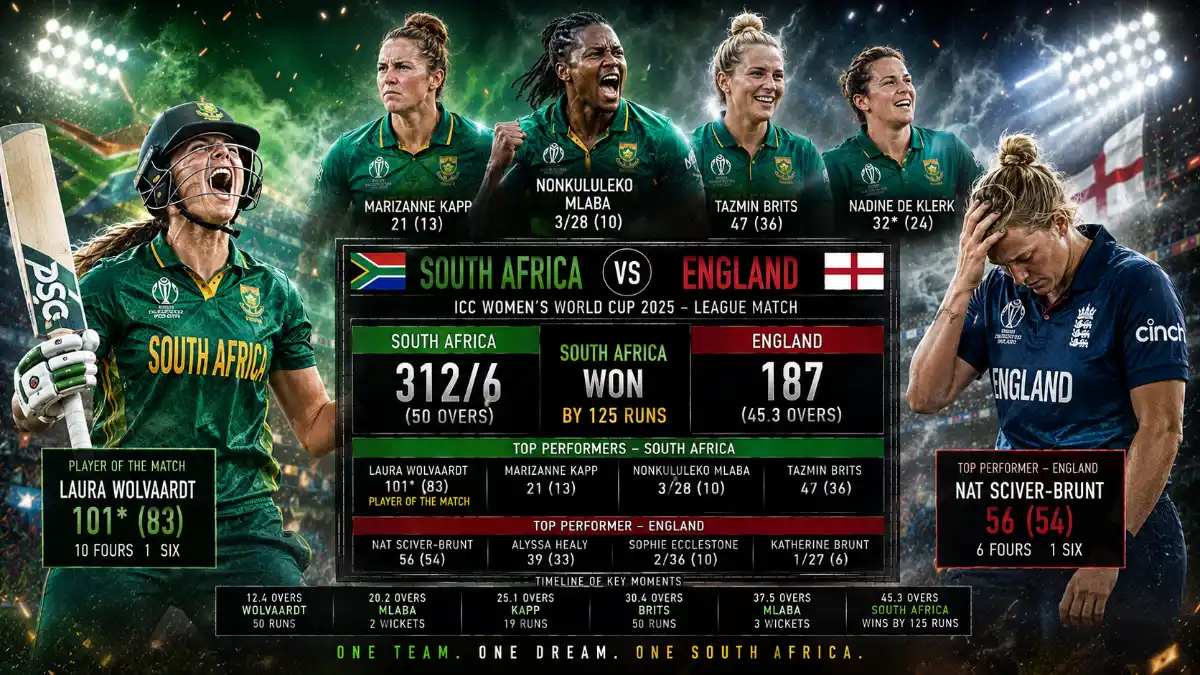
England Women beat South Africa Women by 40 runs in the second semi-final of the ICC Women’s T20 World Cup 2026, posting 169/5 at The Oval before restricting the Proteas to 129/8. Nat Sciver-Brunt’s match-defining 75 and Heather Knight’s composed 58 built a 133-run partnership that turned a shaky start into a match-winning total, sending England into the final against Australia at Lord’s. This detailed breakdown of the South Africa Women’s National Cricket Team vs England Women’s National Cricket Team match scorecard covers every key passage of play, the batting and bowling cards, and what the result meant for both sides heading into the tournament’s business end.
South Africa Women vs England Women Match Scorecard Summary
The match at The Oval on July 2, 2026, told the story of two very different starts and one decisive partnership that swung the contest firmly in England’s favor. South Africa Women won the toss and chose to field first, a call that initially paid off as Marizanne Kapp and Shabnim Ismail reduced England to 23/3 inside the powerplay.
| Team | Score | Overs | Result |
| England Women | 169/5 | 20 | Won by 40 runs |
| South Africa Women | 129/8 | 20 | Lost the semi-final |
Ismail struck with the very first ball of the match to remove Amy Jones, then trapped Alice Capsey lbw, while Kapp bowled Danni Wyatt-Hodge – the tournament’s leading run-scorer – with a delivery that nipped back sharply off the seam. Ismail also became the first bowler to reach 50 wickets at Women’s T20 World Cups during the innings, underlining South Africa’s new-ball threat even in defeat.
England’s Road to the Semi-Final
England Women arrived at The Oval as one of two unbeaten sides remaining in the tournament, having won all five of their group-stage fixtures. Their campaign included a commanding nine-wicket win over New Zealand to finish the group phase with a perfect record and a 38-run victory over the West Indies that sealed their semi-final berth. Across the group stage, England’s top three – Wyatt-Hodge, Sciver-Brunt and Knight – had already established themselves as the tournament’s most consistent batting unit, scoring at a healthy rate against every attack they faced.
That form made England firm favourites heading into the semi-final against South Africa, and pundits pointed specifically to their top order’s ability to counter-attack even when early wickets fell. The Sciver-Brunt–Knight partnership at The Oval validated that reputation, delivering exactly the kind of recovery England had shown themselves capable of throughout the competition.
England Women Innings: Sciver-Brunt and Knight Rebuild
Nat Sciver-Brunt’s 75 off 47 balls anchored England’s recovery from 23/3, combining with Heather Knight’s 58 in a 133-run partnership for the third wicket – the highest stand in a knockout match in the tournament’s history. Returning from a calf injury that had ruled her out of England’s previous three matches, Sciver-Brunt batted with clear intent from the outset, striking 11 fours and a six on her way to her eighth Women’s T20 World Cup half-century, a tally that puts her level with New Zealand’s Suzie Bates and Australia’s Beth Mooney on the all-time list.
Knight matched her captain’s composure, reaching her own fifty with a six over deep midwicket before falling in the penultimate over of the innings. South Africa’s Nonkululeko Mlaba broke the stand with two wickets in the 19th over, dismissing Sciver-Brunt and then Knight two balls later, but by then the damage to South Africa’s bowling figures and England’s total was already done. England finished on 169/5, with Kapp bowling economically for figures of 1/16 despite the pressure her early breakthrough had applied.
England Women full batting card:
| Batter | Runs | Balls | 4s | 6s | Dismissal |
| Amy Jones | 3 | 1 | 0 | 0 | Caught (Ismail) |
| Danni Wyatt-Hodge | 20 | 27 | 5 | 4 | Bowled (Kapp) |
| Alice Capsey | 3 | 5 | 0 | 0 | LBW (Ismail) |
| Nat Sciver-Brunt | 75 | 47 | 11 | 1 | Caught (Mlaba) |
| Heather Knight | 58 | 47 | 6 | 1 | Caught (Mlaba) |
| Freya Kemp | 1* | 3 | 0 | 0 | Not out |
| Danielle Gibson | 6* | 6 | 1 | 0 | Not out |
The scoreline masks how precarious England’s position looked inside the first four overs. Losing Jones, Capsey and Wyatt-Hodge in quick succession would have derailed most batting orders, but Sciver-Brunt’s calmness at the crease – despite her own admission of nerves given the occasion – allowed England to absorb the pressure and reset their innings around the 133-run stand.
South Africa Women’s Chase Falls Apart
Chasing 170, South Africa Women were undone by a lack of partnerships after Wolvaardt and Tazmin Brits added 43 for the opening wicket. Sophie Ecclestone took a leaping catch off Linsey Smith to remove captain Laura Wolvaardt for 17, and from there South Africa lost wickets at regular intervals, never allowing their innings to build the kind of momentum England’s had found. Brits fought a lone battle after Wolvaardt’s dismissal, reaching her half-century off 44 balls with six boundaries, only to fall the very next delivery for 51 when a leading edge off Charlie Dean flew to Sciver-Brunt at mid-off.
Once Brits departed, South Africa’s innings unraveled quickly. Annerie Dercksen, Kapp and Sune Luus all got starts without converting them into meaningful scores, and the side eventually finished at 129/8, comfortably short of the target. Laura Wolvaardt later reflected on the collapse, noting that her batting mindset – not her technique – needed resetting after the tournament, acknowledging that the top order had simply failed to build the partnerships England had managed.
South Africa Women full batting card:
| Batter | Runs | Balls | Dismissal |
| Laura Wolvaardt | 17 | 15 | Caught (Ecclestone) |
| Tazmin Brits | 51 | 45 | Caught (Sciver-Brunt) |
| Annerie Dercksen | 3 | 6 | Caught |
| Marizanne Kapp | 5 | 7 | Caught |
| Sune Luus | 11 | 13 | Caught |
| Nadine de Klerk | 14* | 14 | Not out |
| Chloe Tryon | 12 | 11 | Bowled |
| Sinalo Jafta | 1 | 4 | Run out |
| Ayabonga Khaka | 4 | 3 | Bowled |
| Shabnim Ismail | 2* | 2 | Not out |
Read More: South Africa Women’s National Cricket Team vs England Women’s National Cricket Team Match Scorecard
Bowling Performances That Decided the Match
Lauren Bell and Charlie Dean were England’s most effective bowlers, each taking 2/28 and 2/31 respectively, while Linsey Smith, Sophie Ecclestone and Freya Kemp claimed one wicket apiece to complete a disciplined bowling display. Ecclestone’s early removal of Wolvaardt proved particularly costly for South Africa, since it broke the innings’ most promising partnership before it could truly accelerate. On the South African side, Ismail and Mlaba finished with two wickets each, but their efforts – including Ismail’s record-breaking 50th World Cup wicket – came too late in the piece to prevent England’s middle-order recovery.
England Women bowling figures:
| Bowler | Overs | Runs | Wickets | Economy |
| Linsey Smith | 4.0 | 25 | 1 | 6.25 |
| Lauren Bell | 4.0 | 28 | 2 | 7.00 |
| Charlie Dean | 4.0 | 31 | 2 | 7.75 |
| Sophie Ecclestone | 4.0 | 21 | 1 | 5.25 |
| Freya Kemp | 3.0 | 11 | 1 | 3.66 |
| Danielle Gibson | 1.0 | 6 | 0 | 6.00 |
Key Turning Points of the Semi-Final
The Sciver-Brunt–Knight partnership was the single biggest turning point, converting a 23/3 collapse into a defendable 169/5. Two other moments shaped the eventual 40-run margin:
- Ismail and Kapp’s fiery opening burst nearly derailed England before the middle order steadied the innings and rebuilt momentum from the depths of the powerplay
- Ecclestone’s early breakthrough to remove Wolvaardt broke South Africa’s platform-building opening stand and triggered a batting collapse that South Africa never recovered from
- Sciver-Brunt’s tactical bowling changes and field placements as captain kept South Africa’s required run rate climbing throughout the chase, denying the Proteas any period of calm
England vs South Africa: A One-Sided Head-to-Head Record
England Women’s dominance over South Africa Women in this fixture is not a recent phenomenon – it reflects a long-standing pattern in T20 internationals between the two sides. Going into the semi-final, England had won 23 of their previous 28 T20I meetings against South Africa, with South Africa managing just four wins and one match ending without a result. That head-to-head record made England the clear favorites even before a ball was bowled at The Oval, though South Africa had shown they were capable of an upset, having knocked England out of the last two major ICC World Cups at the semi-final stage – the 2023 T20 World Cup in Cape Town and the 2025 ODI World Cup in Guwahati.
This victory therefore carried extra significance beyond the immediate result. England’s win avenged those two painful exits and ended a mini-hoodoo South Africa had held over them in knockout cricket, even as England’s overall head-to-head superiority in bilateral series remained intact throughout. In the 2024 T20 World Cup group meeting between the sides in Sharjah, England had also prevailed by seven wickets, extending their recent stranglehold on the fixture.
Player of the Match and Post-Match Reactions
Nat Sciver-Brunt was named Player of the Match for her 75 off 47 balls, an innings that marked a successful return from injury and doubled as a statement of intent ahead of the final. Speaking after the game, she admitted to feeling the weight of the occasion: “I was obviously nervous. Probably the occasion gets quite big as well, and it increases the nerves,” she said, crediting the composure shown by England’s batting lineup once the early wickets had fallen.
For South Africa, the tone was understandably more reflective. Wolvaardt pinpointed the absence of substantial partnerships as the difference between the two sides: “They had those really big partnerships, and we didn’t have any and none of the batters got going,” she said, a sentiment that captured South Africa’s broader struggle to convert individual starts into a match-winning total.
What the Result Meant for the Final
England Women’s win set up a summit clash against an unbeaten Australia side at Lord’s on Sunday, July 5, 2026, in a rematch of one of women’s cricket’s fiercest modern rivalries. Both finalists arrived unbeaten, having dismantled the tournament’s toughest group in the case of Australia and cruised through their own group in England’s case, setting up a contest widely billed as a clash between the tournament’s two form teams. England went in chasing their second title and first since the inaugural 2009 edition – also held at Lord’s – while Australia targeted a record-extending seventh Women’s T20 World Cup crown.
The final itself did not go England’s way. Australia chased down England’s total with seven wickets and 17 balls to spare, extending their dominance over England across formats to eight consecutive matches since July 2023. England head coach Charlotte Edwards was candid afterward about the gap that still existed: “They have paved the way for many years. Their depth enables them to perform at the top level. To defeat them, you need to be at your peak, and we weren’t,” she said, reflecting on a tournament that nonetheless represented a significant step forward for the host nation.
For South Africa, the semi-final exit continued a pattern of falling at crucial junctures in ICC events, despite possessing one of the most experienced bowling attacks in the women’s game led by Ismail and Kapp. The Proteas’ challenge going forward, as Wolvaardt acknowledged, lies less in personnel and more in translating individual starts into the kind of substantial partnerships that decide knockout matches.
Why This Match Mattered Beyond the Scorecard
Beyond the numbers, the South Africa Women vs England Women semi-final scorecard captured a recurring theme in modern women’s T20 cricket: the value of a settled middle order capable of absorbing early shocks. England’s top three had been the tournament’s most reliable unit throughout the group stage, and the Sciver-Brunt–Knight stand at The Oval was a direct continuation of that trend rather than an isolated act of individual brilliance. South Africa, by contrast, possessed the bowling depth to trouble any top order – as their opening burst proved – but lacked the batting consistency to back it up once the contest moved into the chase.
That contrast between bowling depth and batting fragility has defined South Africa’s recent ICC tournament campaigns, and it resurfaced again in this semi-final despite home advantage lying with the opposition. For England, the match served as a dress rehearsal for the pressure of a World Cup final – a test that ultimately exposed the gap that still separates them from Australia at the very top of the women’s game, even as it confirmed the depth and resilience of a batting order capable of winning matches from difficult positions.
Frequently Asked Questions
What was the final score in the South Africa Women vs England Women match scorecard?
England Women scored 169/5 in 20 overs, and South Africa Women were bowled out for 129/8 in reply, giving England a 40-run win in the semi-final at The Oval.
Who won the toss in the England vs South Africa semi-final?
South Africa Women won the toss and elected to field first, hoping their new-ball bowlers could exploit early conditions at The Oval, a plan that worked initially before England’s middle order recovered.
Who was named Player of the Match?
Nat Sciver-Brunt was named Player of the Match for her 75 off 47 balls, which rebuilt England’s innings after an early top-order collapse to 23/3.
What was the highest partnership of the match?
The 133-run stand between Nat Sciver-Brunt and Heather Knight for England’s third wicket was the highest partnership of the innings and the highest in a knockout match in the tournament’s history.
Who was South Africa’s top scorer in the chase?
Tazmin Brits top-scored for South Africa with 51 off 45 balls, though she received little support once she was dismissed the ball after reaching her fifty.
Which bowlers picked up wickets for England?
Lauren Bell and Charlie Dean each took two wickets, while Linsey Smith, Sophie Ecclestone and Freya Kemp added one wicket apiece to restrict South Africa to 129/8.
How many wickets did Shabnim Ismail take for South Africa?
Shabnim Ismail took two wickets, including the opening-delivery dismissal of Amy Jones, and became the first bowler to reach 50 wickets in Women’s T20 World Cup history during the innings.
Why did South Africa Women lose the semi-final despite a strong bowling start?
South Africa reduced England to 23/3 early but could not maintain the pressure once Sciver-Brunt and Knight settled in, and their own batting then collapsed after losing Wolvaardt and Brits cheaply, leaving no substantial partnerships to chase down 170.
What is the head-to-head record between England Women and South Africa Women in T20Is?
Heading into the semi-final, England had won 23 of their 28 previous T20I meetings against South Africa, with South Africa winning four and one match ending without a result, making England heavy favourites in the fixture.
Who did England Women play in the final after beating South Africa, and what was the result?
England Women advanced to face Australia Women in the final at Lord’s, but Australia won the match by seven wickets with 17 balls remaining to claim their record-extending seventh Women’s T20 World Cup title.