

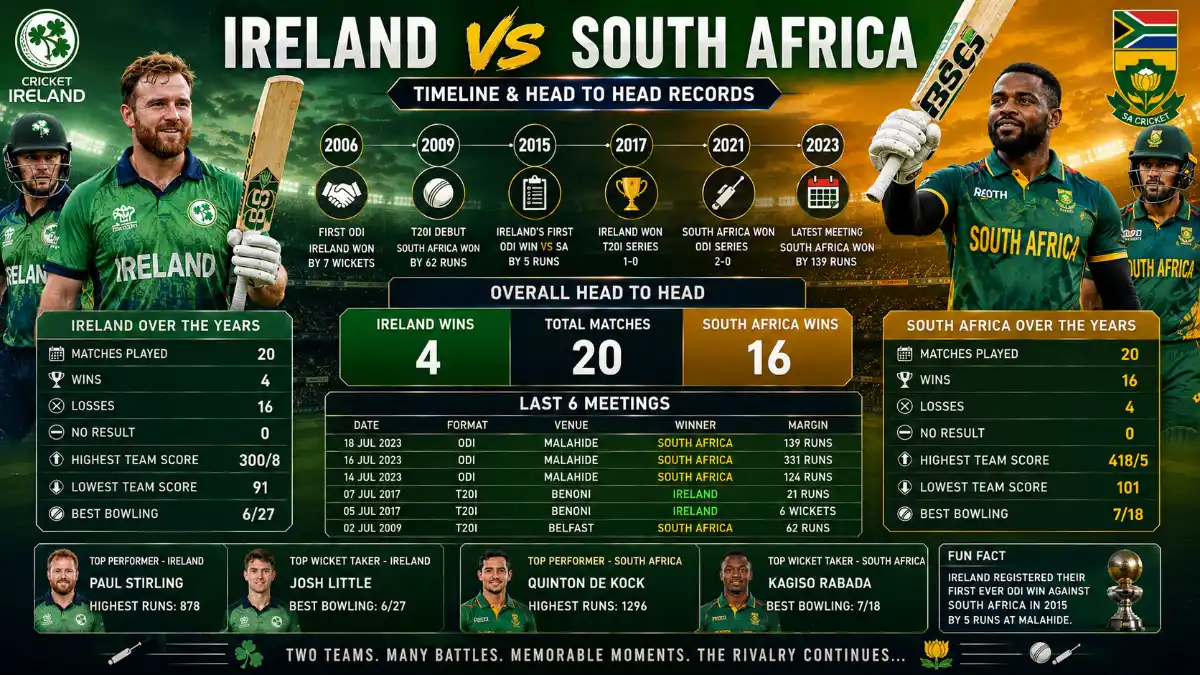
South Africa leads the Ireland cricket team vs South Africa national cricket team timeline with 24 wins from 30 completed internationals, but Ireland’s landmark 2024 T20I victory in Abu Dhabi marked the sharpest turning point in this long-running rivalry. This guide covers every match, format breakdown, key record, and statistical milestone between these two nations, built for readers who want the complete picture rather than a partial scorecard summary.
Who Leads the Head-to-Head?
South Africa dominates the overall record, winning 24 of 30 matches, while Ireland has claimed 5 wins and one match ended without a result. This makes the Ireland cricket team vs South Africa national cricket team timeline one of the more one-sided rivalries involving a Full Member nation, though the gap has narrowed noticeably in the last five years. South Africa also holds separate advantages in both the ODI and T20I formats, which reinforces just how difficult this fixture has historically been for Ireland’s white-ball setup.
Overall Head-to-Head Snapshot
- Total matches played: 30
- South Africa wins: 24
- Ireland wins: 5
- No result: 1
- Win percentage for South Africa: roughly 80%
Head-to-Head by Format
In ODIs, South Africa lead 8-2 from 11 completed matches, while in T20Is, South Africa hold a 4-2 advantage across six meetings. These numbers matter because they show Ireland’s competitiveness has been format-dependent rather than uniform – Ireland’s T20I improvement has outpaced their ODI progress against the same opponent.
| Format | Matches | South Africa Wins | Ireland Wins | No Result |
| ODI | 11 | 8 | 2 | 1 |
| T20I | 6 | 4 | 2 | 0 |
| Combined (all formats) | 30 | 24 | 5 | 1 |
Why the Format Split Matters
Ireland’s T20I improvement is not accidental. The format rewards explosive middle-order hitting and tight death bowling – two areas where Ireland’s newer generation of players, particularly all-rounders capable of finishing innings under pressure, has developed faster than their long-format or 50-over game. This is the core reason Ireland’s most competitive results against South Africa have clustered in white-ball cricket rather than Test matches.
Complete Match-by-Match Timeline
The full Ireland vs South Africa match-by-match record spans from a 2007 World Cup meeting in the Caribbean to a 2024 series in Abu Dhabi, where Ireland claimed their first-ever T20I win over the Proteas. Below is every completed result in chronological order.
| Date | Format | Result | Venue |
| April 2007 | ODI | South Africa won (D/L method) | West Indies |
| June 2007 | ODI | South Africa won by 42 runs | Belfast |
| March 2011 | ODI | South Africa won by 131 runs | Kolkata |
| March 2015 | ODI | South Africa won by 201 runs | Canberra |
| September 2016 | ODI | South Africa won by 206 runs | Benoni |
| July 2021 | ODI | No result | Dublin |
| July 2021 | ODI | Ireland won by 43 runs | Dublin |
| July 2021 | ODI | South Africa won by 70 runs | Dublin |
| August 2022 | T20I | South Africa won | Bristol |
| August 2022 | T20I | South Africa won | Bristol |
| September 2024 | T20I | South Africa won by 8 wickets | Abu Dhabi |
| September 2024 | T20I | Ireland won by 10 runs | Abu Dhabi |
| October 2024 | ODI | South Africa won by 139 runs | Abu Dhabi |
| October 2024 | ODI | South Africa won by 174 runs | Abu Dhabi |
| October 2024 | ODI | Ireland won by 69 runs | Abu Dhabi |
Read More: Ireland Cricket Team vs South Africa National Cricket Team Timeline
The Pattern Hidden in the Numbers
This table reveals something a simple narrative summary misses entirely: Ireland’s five all-time wins are concentrated into just two short windows – three matches in July 2021 and two matches during the October 2024 UAE tour – rather than being spread evenly across nearly two decades. That clustering tells us Ireland’s competitiveness against South Africa depends heavily on specific squad form and conditions, rather than reflecting a smooth, steady year-on-year climb up the competitive ladder.
Top Run Scorers in the Rivalry
Janneman Malan leads all batters in the Ireland vs South Africa fixture with 265 runs, followed by Ireland’s Harry Tector on 228 runs. South African batters dominate the upper half of the run-scoring charts, which reflects the broader batting depth gap between the two sides across most of this rivalry’s history.
Leading Run Scorers Table
| Rank | Player | Team | Runs |
| 1 | Janneman Malan | South Africa | 265 |
| 2 | Harry Tector | Ireland | 228 |
| 3 | Reeza Hendricks | South Africa | 218 |
| 4 | Quinton de Kock | South Africa | High volume across formats |
| 5 | Andrew Balbirnie | Ireland | 232 (ODI only) |
Malan’s tally is significant mainly because it was built almost entirely during the 2024 UAE series, where he struck an unbeaten 177 – the highest individual score recorded in this head-to-head rivalry. Tector and Balbirnie’s numbers, by contrast, come from steadier contributions across multiple series, which arguably says more about Ireland’s improving middle-order consistency than one standout innings does.
Highest and Lowest Team Totals
South Africa’s highest total against Ireland stands at 346/4, scored during the 2021 Dublin ODI series, while Ireland’s best response in that same series was 290/5. These numbers matter because they show Ireland’s most competitive batting performances have come on home soil in Dublin, not in neutral UAE conditions where seam and bounce typically favor South Africa’s attack.
Lowest Totals and Collapses
South Africa’s lowest completed total against Ireland sits at 131, while Ireland was restricted to as low as 132 during the 2024 UAE series opener. Both collapses occurred under sustained new-ball pressure rather than against spin, which highlights a shared vulnerability against high-quality pace bowling in helpful conditions – a theme that recurs throughout this Ireland cricket team vs South Africa national cricket team timeline.
Biggest Wins and Closest Finishes
South Africa’s largest margin of victory in this rivalry is 206 runs, recorded at Benoni in 2016, closely followed by their 201-run win at the 2015 World Cup in Canberra. Ireland’s biggest and most celebrated win remains their 2024 T20I breakthrough by 10 runs – a far tighter margin, but one loaded with far greater psychological significance than any of South Africa’s blowout victories.
The Closest Contests
The tightest ODI finish in the rivalry came during the July 2021 Dublin series, when Ireland won by 43 runs. That may look comfortable on paper, but by the standards of a head-to-head where most completed matches have been decided by 70 runs or more, it counts as one of the more competitive finishes on record.
2024: Ireland’s Historic T20I Breakthrough
Ireland recorded their first-ever T20I win over South Africa on September 29, 2024, in Abu Dhabi, with Mark Adair’s century sealing a 10-run victory and ending a six-match losing run in the format. This single result reshaped the psychological balance of the rivalry more than any statistic in the previous 17 years.
What Made the Win Different
Since gaining ICC Full Membership status in 2018, Ireland have posted their first T20I win over South Africa and their first ODI series-closing win in the format since 2021, signaling structural progress rather than a one-off fluke. The win arrived just two days after South Africa had beaten Ireland by 8 wickets in the series opener – which sharpens the significance considerably, since Ireland adjusted their bowling lengths and batting intent within 48 hours rather than needing a full squad rebuild.
The accompanying ODI series told a slightly different story. South Africa won the first two matches comfortably, by 139 and 174 runs, before Ireland closed out the series with a spirited 69-run win to avoid a clean sweep. Ireland’s bowlers made a visible tactical shift in that final match, targeting South Africa’s top order with fuller, more attacking lengths rather than sitting back defensively – a change reflected directly in South Africa’s collapse to one of their lowest totals ever recorded against Ireland.
2026: Women’s Warm-Up Extends the Rivalry
South Africa Women beat Ireland Women in a rain-affected warm-up fixture at Loughborough in June 2026, ahead of the ICC Women’s T20 World Cup. Although a warm-up match carries no series weight or ranking implications, the result extends South Africa’s broader dominance across both men’s and women’s cricket in this fixture, suggesting the gap in depth extends beyond the senior men’s setup alone.
Why This Result Still Matters
Warm-up matches rarely make headlines, but they often reveal squad depth and bench strength ahead of major tournaments. South Africa’s win here, though modest in stakes, reinforces a pattern seen throughout this rivalry: their pace-bowling depth consistently creates problems for Ireland’s top order, regardless of format or gender.
Why This Rivalry Matters Going Forward
Ireland’s 2024 breakthrough – combining their first T20I win with a series-closing ODI victory during the same UAE tour – represents the clearest evidence yet that the historical 24-5 gap is beginning to narrow in specific formats and conditions, even though the overall head-to-head remains firmly tilted toward South Africa. For South Africa, these fixtures continue to function as valuable squad-depth tests outside marquee series against India, England, and Australia, where rotation and experimentation carry lower risk.
What to Watch Next
The next assignment for both senior sides will likely arrive through future ICC white-ball tournaments or bilateral tours, where Ireland will look to build on the psychological breakthrough of 2024 rather than treat it as an isolated highlight. Whether Ireland can sustain that competitiveness across a full series, rather than a single standout match, will determine if this rivalry becomes genuinely competitive or remains a story of occasional upsets against a dominant opponent.
Data Notes
Match results, head-to-head figures, and player statistics referenced in this article are compiled from official cricket records archives and verified scorecards. All win-loss figures reflect completed internationals only; abandoned and no-result matches are counted separately and excluded from win-percentage calculations, in line with standard cricket record-keeping practice.
10 Frequently Asked Questions
How many times have Ireland and South Africa played each other in cricket?
Ireland and South Africa have met 30 times across all international formats, with South Africa winning 24 of those matches.
Has Ireland ever beaten South Africa in a T20I?
Yes, Ireland recorded their first T20I win over South Africa on September 29, 2024, in Abu Dhabi, winning by 10 runs behind a Mark Adair century.
Who is the top run scorer in Ireland vs South Africa matches?
Janneman Malan of South Africa leads with 265 runs, followed closely by Ireland’s Harry Tector on 228 runs.
What is the highest team total recorded in an Ireland vs South Africa match?
South Africa’s highest total against Ireland is 346/4, scored during the 2021 Dublin ODI series.
What is South Africa’s biggest win over Ireland by margin?
South Africa’s largest victory margin is 206 runs, recorded at Benoni in September 2016.
What was the result of the 2024 Ireland vs South Africa ODI series?
South Africa won the three-match series 2-1, with Ireland winning the final match by 69 runs.
Did Ireland and South Africa’s women’s teams play recently?
Yes, South Africa Women won a rain-affected warm-up fixture against Ireland Women at Loughborough in June 2026, ahead of the T20 World Cup.
What is Ireland’s biggest and most significant win over South Africa?
Ireland’s 10-run T20I win in Abu Dhabi on September 29, 2024, remains their most significant victory in the rivalry, both statistically and psychologically.
How does South Africa’s ODI record compare to its T20I record against Ireland?
South Africa leads the ODI head-to-head 8-2 and the T20I head-to-head 4-2, holding the advantage in both white-ball formats.
Is Ireland a Full Member of the International Cricket Council?
Yes, Ireland gained Test status and Full ICC membership in 2018, a milestone that coincides closely with their first competitive series wins over South Africa in the years that followed.