

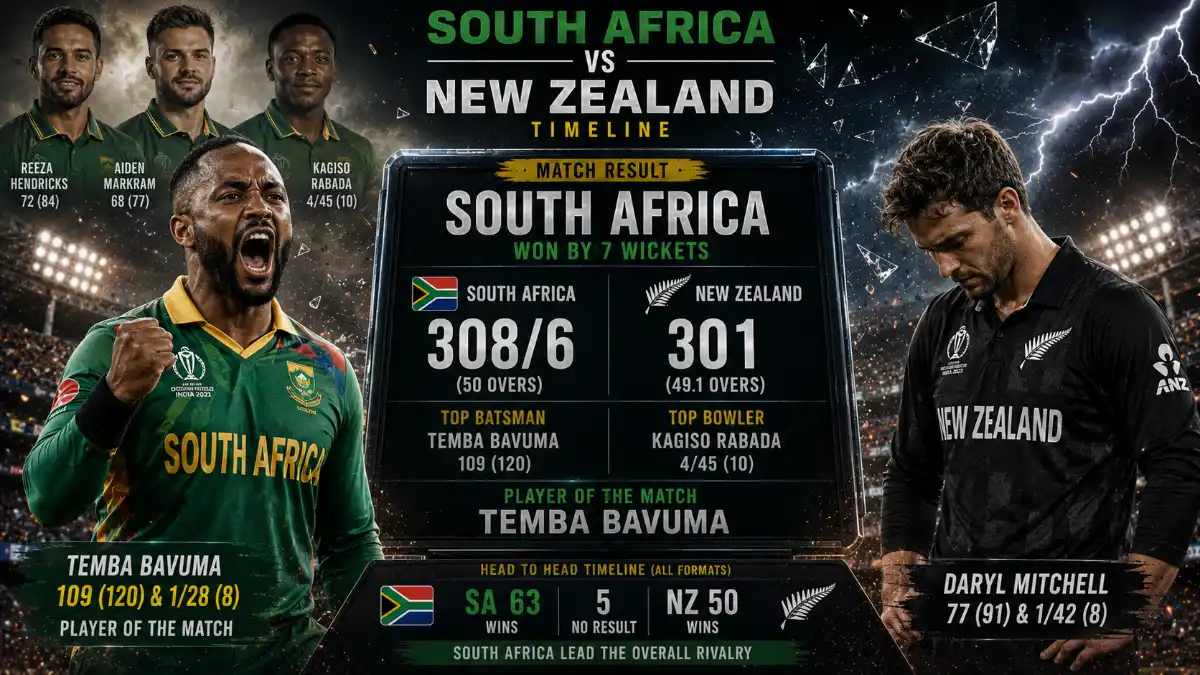
The South Africa national cricket team vs New Zealand national cricket team timeline spans nearly a century, but its defining chapter came in 2026 with a dramatic World Cup semi-final and a hard-fought five-match ODI series. South Africa leads the overall ODI rivalry with 42 wins in 74 matches.
New Zealand, however, has dominated the ICC World Cup stage, winning six of nine meetings. This contrast-South Africa’s bilateral success versus New Zealand’s knockout dominance-has made the rivalry one of international cricket’s most compelling contests.
Understanding the South Africa vs New Zealand Cricket Rivalry
South Africa and New Zealand have built a rivalry defined by a strange paradox: South Africa wins more often, but New Zealand wins when it matters most. Across ODIs, Tests, and T20Is combined, South Africa have won seven of eleven series meetings historically, yet their World Cup record against the Black Caps tells a completely different story.
Why This Rivalry Is Different From Other Cricket Contests
Unlike the England-Australia Ashes rivalry, which is steeped in colonial history, or India-Pakistan clashes, which carry geopolitical weight, the South Africa vs New Zealand cricket contest is purely a battle of contrasting team philosophies. South Africa has traditionally relied on raw pace-bowling depth and explosive middle-order batting, while New Zealand’s identity is built on tactical discipline, calm decision-making under pressure, and situational batting intelligence. When these two approaches collide in ICC knockout cricket, New Zealand’s composure has repeatedly won out – a pattern that has now repeated itself six times across nine World Cup meetings.
The Bilateral vs Tournament Divide
In bilateral cricket, South Africa has been the significantly stronger side across generations. They have won eight of ten bilateral ODI series against New Zealand, with an overall ODI head-to-head of 42 wins to 27, and five matches ending without a result. This bilateral dominance stems largely from South Africa’s superior fast-bowling stocks over the decades and home conditions that have traditionally favored seam and bounce – conditions New Zealand batting line-ups have historically found difficult to master away from home.
Complete Head-to-Head Record Breakdown
Understanding the numbers behind the South Africa national cricket team vs New Zealand national cricket team timeline requires looking beyond a single win-loss column, because the format completely changes the story.
South Africa leads the overall ODI head-to-head 42-27 from 74 matches, but New Zealand holds a 6-3 advantage specifically in World Cup fixtures between the two sides.
ODI Format Statistics
- Total ODI matches played: 74
- South Africa wins: 42
- New Zealand wins: 27
- Matches with no result: 5
- Bilateral series won by South Africa: 8 out of 10
World Cup Head-to-Head
- Total World Cup meetings: 9
- New Zealand wins: 6
- South Africa wins: 3
- This tournament-specific gap is the most statistically significant anomaly in the entire rivalry.y
Test Match History
The Test rivalry dates back to South Africa’s 1931/32 tour of New Zealand, where South Africa won the series 2-0. Test cricket between these two nations has historically been sporadic compared to their limited-overs meetings, largely due to scheduling gaps during South Africa’s isolation era and the modern era’s congested white-ball calendar. Recent Test meetings have shown a strong home-advantage pattern, with the host nation typically dictating terms through pitch preparation suited to their own bowling attack.
Read More: South Africa National Cricket Team vs New Zealand National Cricket Team Timeline
The 2026 T20 World Cup Semi-Final: A Rivalry-Defining Moment
New Zealand defeated South Africa by 9 wickets in the 1st Semi-Final of the ICC Men’s T20 World Cup 2026, chasing down 170 with 43 balls to spare.
This single match may be the most important entry in the entire South Africa national cricket team vs New Zealand national cricket team timeline of the past decade, because it broke a psychological barrier that had stood for years.
Why This Result Shocked Even Neutral Observers
Heading into the semi-final, South Africa had never lost to New Zealand in a T20 World Cup match and were carrying an unbeaten run of seven consecutive wins in the tournament. They were tournament favorites by most measures – strong batting depth, a settled bowling attack, and momentum from the group stages. New Zealand’s response flipped the script entirely.
South Africa were bowled out for 169/8, a total that looked competitive on paper but never accounted for how clinically New Zealand’s top order would respond. New Zealand chased the target down in just 12.5 overs, finishing at 173/1 – a run rate that turned a high-stakes knockout match into a batting exhibition rather than a contest.
Tactical Breakdown of the Semi-Final Collapse
The turning point wasn’t a single over – it was South Africa’s inability to generate early pressure with the new ball. Once New Zealand’s openers survived the powerplay without losing early wickets, the required run rate dropped so quickly that South Africa’s captaincy options became limited. Field placements built for containment became irrelevant once the asking rate fell below six an over with wickets in hand, and South Africa’s bowling changes late in the innings had no defensive value left to offer.
This defeat wasn’t about a lack of skill – it was about momentum compounding in New Zealand’s favor the moment the powerplay ended cleanly. In T20 cricket, a clean top-order start against a fancied bowling attack often decides the match well before the midpoint, and that is exactly what unfolded at Eden Gardens.
March 2026 Bilateral T20I Series: South Africa’s Response
South Africa won the five-match T20I series against New Zealand 3-2, recovering from a 2-1 deficit to close out the series at Hagley Oval, Christchurch.
Scheduled almost immediately after the World Cup heartbreak, this series functioned as an emotional and tactical reset for South Africa. The series scoreline alone doesn’t capture how dramatically momentum swung from match to match.
Match-by-Match Tactical Analysis
1st T20I – Bay Oval, Mount Maunganui: South Africa responded to the World Cup exit immediately, bowling New Zealand out for just 91 and chasing the target down in 16.4 overs for a 7-wicket win. This was a statement of intent – South Africa’s bowlers targeted New Zealand’s middle order with short-of-length deliveries, a plan that worked to perfection on a pitch offering extra bounce.
2nd T20I – Seddon Park, Hamilton: New Zealand hit back with their most dominant performance of the series, posting 175/6 and restricting South Africa to just 107 all out for a 68-run win. South Africa’s batting approach in the powerplay was too passive, allowing New Zealand’s spinners to settle into rhythm during the middle overs – a tactical misstep that cost them the initiative for the rest of the series.
3rd T20I – Eden Park, Auckland: New Zealand went 2-1 up in the series, chasing 137 with 8 wickets in hand. This was arguably South Africa’s lowest point of the tour, as their total of 136 never looked competitive against a New Zealand batting order that had found its confidence again.
4th T20I – Sky Stadium, Wellington: Facing series elimination pressure, South Africa found their nerve at exactly the right moment. Defending 164/5, they won by 19 runs to level the series at 2-2. This match showcased South Africa’s ability to bowl smart, disciplined death overs under genuine pressure – a skill that had gone missing earlier in the tour.
5th T20I – Hagley Oval, Christchurch: South Africa closed out the series in style, posting 187/4 and restricting New Zealand to 154/8 for a comfortable 33-run win. The series decider showed South Africa’s batting depth at its best, with contributions coming from multiple positions in the order rather than relying on a single match-winning performance.
The Real Story Behind the 3-2 Scoreline
What stands out in this series isn’t the final result – it’s South Africa’s response pattern. Twice during the tour, South Africa fell behind in the series, and twice they answered with their strongest performances in the very next match. This kind of bounce-back mentality, rather than any individual brilliance, is what ultimately decided the series in South Africa’s favor.
Format-by-Format Strengths: A Tactical Comparison
Understanding where each team holds the advantage requires breaking the rivalry down by format, since conditions and match length change everything about how these two sides approach each other.
| Format | Stronger Team | Key Reason |
| ODI (Bilateral) | South Africa | Superior pace-bowling depth and batting consistency over 50 overs |
| T20I (Bilateral) | Evenly matched | Recent series have swung on individual match momentum rather than clear superiority |
| World Cup Knockouts | New Zealand | Tactical composure under maximum pressure situations |
| Test Matches | Host nation advantage | Home conditions and pitch preparation dictate outcomes more than form |
Why the South Africa vs New Zealand Rivalry Matters for World Cricket
This fixture has become a genuine barometer for how teams handle knockout pressure in the modern game. New Zealand’s consistent success in World Cup settings against South Africa – six wins from nine meetings – suggests a team culture built specifically around big-match temperament, regardless of who holds the stronger squad on paper. South Africa’s bilateral dominance, on the other hand, points to greater overall depth and consistency when the pressure of a single elimination game isn’t a factor.
The March 2026 series result adds an important layer to this ongoing narrative. A team that had just suffered arguably its most painful knockout defeat in years bounced back within weeks to win a competitive bilateral series – proof that South Africa’s issue isn’t mental fragility across the board, but something specific to the compressed pressure of ICC knockout cricket.
What This Means for Future ICC Tournaments
Going forward, the South Africa national cricket team vs New Zealand national cricket team timeline suggests that any future meeting between these two sides in a World Cup knockout setting should be treated as a genuine coin flip, regardless of recent bilateral form. South Africa’s challenge isn’t building a good enough team – it’s translating bilateral consistency into knockout composure, a gap that has now defined multiple World Cup cycles.
Key Takeaways From the Rivalry
- South Africa leads the all-time ODI head-to-head 42-27, but New Zealand dominates World Cup meetings 6-3
- The 2026 T20 World Cup semi-final ended South Africa’s previously unbeaten record against New Zealand in T20 World Cup history
- South Africa’s response – winning the following bilateral series 3-2 – showed resilience specific to non-knockout cricket
- Test match history between the two sides dates back to 1931/32, with strong home-advantage patterns in recent decades
- Format and match context, more than overall squad strength, appear to be the biggest predictors of outcomes in this rivalry
Frequently Asked Questions
What is the overall head-to-head record between South Africa and New Zealand in ODIs?
South Africa leads 42-27 from 74 ODI matches played, with 5 matches ending without a result.
Did New Zealand beat South Africa in the 2026 T20 World Cup?
Yes, New Zealand won the semi-final by 9 wickets, chasing down South Africa’s total of 169/8 with 43 balls remaining.
Who won the South Africa vs New Zealand T20I series in March 2026?
South Africa won the five-match series 3-2, sealing it with a 33-run victory in the final match at Hagley Oval, Christchurch.
How many times have South Africa and New Zealand met in World Cups?
The two teams have met nine times across World Cup tournaments, with New Zealand winning six of those matches.
Had South Africa ever lost to New Zealand in a T20 World Cup before 2026?
No, before the 2026 semi-final defeat, South Africa held an unbeaten record against New Zealand specifically in T20 World Cup matches.
What was South Africa’s total in the 2026 T20 World Cup semi-final?
South Africa were bowled out for 169/8 in their innings before New Zealand completed the chase comfortably.
How many bilateral ODI series have South Africa won against New Zealand?
South Africa has won eight of the ten bilateral ODI series played against New Zealand historically.
Where was the deciding match of the March 2026 T20I series played?
The series-deciding fifth T20I was played at Hagley Oval in Christchurch, where South Africa won by 33 runs.
In which format does South Africa dominate most against New Zealand?
South Africa’s strongest format advantage comes in bilateral ODI cricket, where their series win record and overall match record are both significantly superior.
Is the South Africa vs New Zealand rivalry considered one of cricket’s major contests?
Yes, it is widely regarded as one of the most competitive and evenly balanced modern rivalries, given South Africa’s bilateral strength contrasted against New Zealand’s tournament pedigree.