
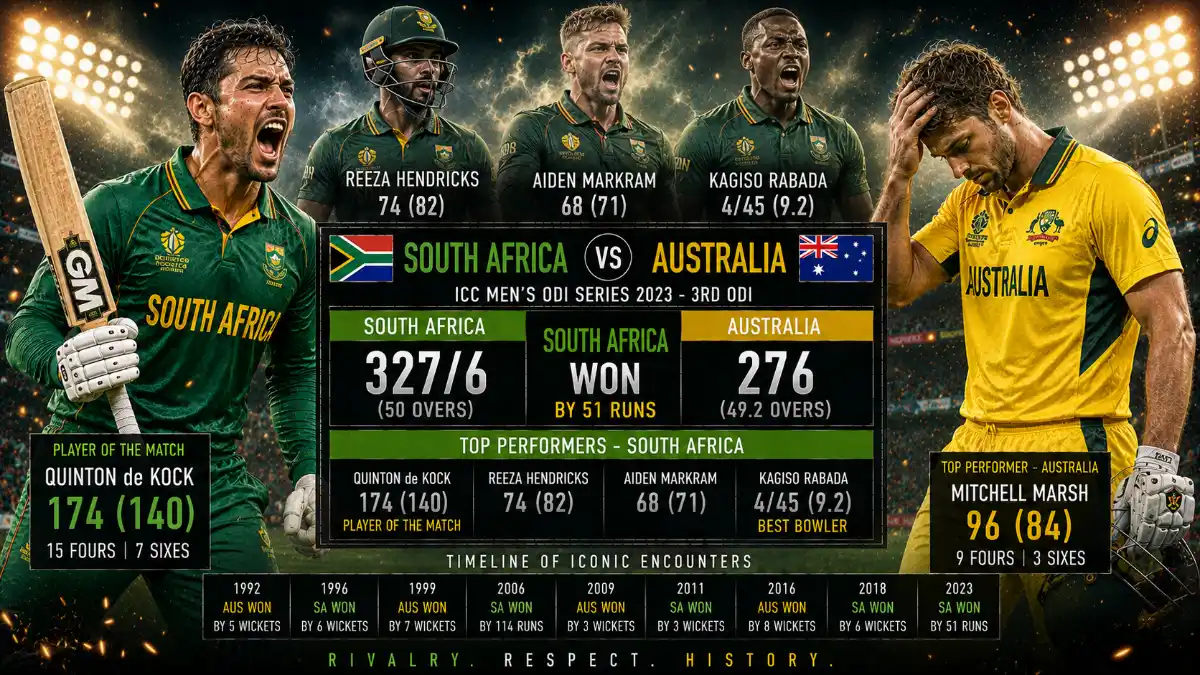
South Africa National Cricket Team vs Australia Cricket Team Timeline: A Complete Cricket Timeline
South Africa and Australia first met in Test cricket in 1902-03, when Australia won the series 2-0. Since then, the South Africa national cricket team vs Australia cricket team timeline has featured the tied 1999 World Cup semi-final, the record 438-run chase in 2006, the 2018 ball-tampering scandal, and South Africa’s maiden ICC title at the 2025 World Test Championship Final.
Few bilateral rivalries carry this much emotional and historical weight. Unlike England-Australia or India-Pakistan, where politics and colonial history shaped the narrative from the outset, South Africa and Australia built their rivalry in fragments – interrupted by isolation, reignited by controversy, and eventually defined by two of the most competitive cricketing cultures on earth. Understanding this South Africa cricket team vs Australia cricket team rivalry means understanding three very different eras of the sport itself.
Full Year-By-Year Timeline Table
| Year | Event | Why It Matters |
| 1902-03 | First-ever Test series; Australia win 2-0 | Set the early tone of Australian dominance in the fixture |
| 1912 | Australia win the Triangular Tournament series | South Africa still searching for their first series win |
| 1935 | South Africa register a landmark Test win on Australian soil | Broke a psychological barrier that had stood for over 30 years |
| 1966-70 | South Africa’s golden generation dominates a rare pre-isolation series | Regarded by many historians as the strongest South African side ever assembled |
| 1970-1991 | No bilateral cricket takes place | A 21-year sporting boycott over apartheid freezes the rivalry entirely |
| 1992 | Official on-field reunion at the Cricket World Cup | Symbolic restart of the South Africa-Australia cricket rivalry on the sport’s biggest stage |
| 1994 | South Africa tour Australia for the first time in over two decades | Re-establishes the bilateral Test relationship |
| 1999 | World Cup semi-final ends in a dramatic tie at Edgbaston | Widely considered one of the greatest ODIs ever played |
| 2006 | The legendary “438 Game” in Johannesburg | Redefines what cricket considered a defendable total |
| 2008-09 | South Africa win a Test series in Australia for the first time in their history | Ends decades of away-form frustration |
| 2011 | Australia bowled out for just 47 in Cape Town | Their lowest Test total since 1902 |
| 2014 | South Africa complete a home series win over Australia | Confirms a shift in home-ground authority |
| 2016 | South Africa whitewash Australia 5-0 in an ODI series | Signals a changing balance in white-ball cricket |
| 2018 | The Sandpapergate scandal erupts in Cape Town | Leads to lengthy bans and a leadership overhaul for Australian cricket |
| 2020 | South Africa win a bilateral ODI series 3-0 | Extends South Africa’s white-ball ascendancy |
| 2023 | South Africa claim their latest bilateral ODI series win | Continues a clear pattern of South African dominance in 50-over cricket |
| June 2025 | South Africa win the World Test Championship Final at Lord’s | South Africa’s first ICC title since 1998 |
| August 2025 | South Africa and Australia split a T20I series | Confirms the rivalry remains fiercely competitive across all formats |
| October 2026 | Australia tour South Africa in the new WTC cycle | The next chapter in an ongoing championship narrative |
Read More: South Africa National Cricket Team vs Australia Cricket Team Timeline
The Early Years: Australian Dominance (1902-1970)
Australia dominated the earliest phase of the rivalry, largely because of superior pace-bowling structures, more frequent international exposure, and stronger domestic professionalisation compared to South Africa’s amateur-heavy setup.
The South Africa vs Australia Test history begins in 1902-03, a period when Australian cricket had already developed a reputation for aggressive, technically sound batting and disciplined fast bowling. South Africa, by contrast, was still developing its first-class structures and lacked the depth of playing talent Australia could call upon. This imbalance persisted for decades, with Australia winning the majority of early encounters comfortably.
Why Australia Held the Early Advantage
- Superior fast-bowling pipeline: Australia’s domestic system produced pace bowlers with more consistent international exposure.
- Greater fixture frequency: Australia played far more international cricket in this era, sharpening match awareness.
- Structural professionalism: Australian cricket moved toward professional standards earlier than South Africa’s amateur-dominated setup.
By 1935, South Africa finally broke through with a landmark win on Australian soil – a result that took over three decades to achieve and signalled the first real shift in competitive balance.
The Isolation Years and Symbolic Rebirth (1970-1994)
South Africa was banned from international cricket between 1970 and 1991 due to the apartheid regime, meaning the rivalry with Australia was completely frozen for 21 years before resuming symbolically at the 1992 Cricket World Cup.
This is arguably the most overlooked chapter in the South Africa cricket team vs Australia timeline. The boycott meant an entire generation of South African cricketers – some considered among the finest the country ever produced – never got the chance to test themselves against Australia on the international stage. When South Africa returned to the fold in 1991-92, the rivalry effectively restarted from zero, stripped of continuity but charged with new emotional stakes.
The 1992 World Cup Reunion
South Africa’s re-entry into world cricket coincided with the 1992 World Cup in Australia and New Zealand – a fitting symbolic backdrop for the rivalry’s rebirth. The Proteas immediately impressed with disciplined fielding standards that would become a hallmark of South African cricket for decades, even as they searched for consistency against a battle-hardened Australian side.
The Golden Era of Drama (1999-2011)
This period produced the two most iconic matches in the rivalry’s history – the tied 1999 World Cup semi-final and the record-breaking 438-run chase in 2006 – cementing South Africa vs Australia as must-watch cricket theatre.
The 1999 World Cup Semi-Final Tie
At Edgbaston, South Africa needed one run off the final ball to reach the World Cup final. Lance Klusener and Allan Donald’s fatal mix-up resulted in a run-out that tied the match at 213 apiece, sending Australia through to the final on superior Super Six standings rather than a genuine on-field defeat. This remains one of the most heartbreaking near-misses in South African cricket history and one of the most replayed finishes in ODI cricket globally.
The 438 Game: Redefining ODI Cricket
On March 12, 2006, at Johannesburg’s New Wanderers Stadium, Ricky Ponting smashed a stunning 164 to power Australia to what seemed an unassailable 434 for 4. What followed shattered every existing assumption about ODI scoring limits. Herschelle Gibbs responded with a blistering 175, and South Africa completed the chase with 438 for 9, winning by one wicket with a single ball to spare. At the time, it was the highest successful run-chase in ODI history and remains one of the most celebrated matches the format has ever produced.
South Africa’s Historic Away Breakthrough
In 2008-09, South Africa achieved something that had eluded them for over a century – a Test series win in Australia, taken 2-1. This victory, built on disciplined bowling and gritty batting performances from the likes of Graeme Smith and AB de Villiers, permanently altered perceptions of South African cricket’s ability to win consistently away from home.
Cape Town, 2011: Australia’s Lowest Ebb
In one of the most sudden collapses in Test cricket history, Australia were bowled out for just 47 in Cape Town – their lowest total since 1902. This single session reshaped the psychological balance of the rivalry, proving that South Africa’s fast-bowling attack could dismantle even the most accomplished batting line-ups under helpful conditions.
Sandpapergate: The Scandal That Shook Australian Cricket
During the third Test in Cape Town in March 2018, Australian player Cameron Bancroft was caught using sandpaper to alter the ball’s condition, leading to 12-month bans for captain Steve Smith and vice-captain David Warner, and reshaping Australian cricket’s leadership structure.
The 2018 South Africa vs Australia Test series will forever be remembered less for cricketing brilliance and more for one of the sport’s biggest integrity scandals. Cameras caught Bancroft attempting to rough up the ball’s surface, and a subsequent investigation revealed both Smith and Warner had prior knowledge of the plan. Cricket Australia handed down unprecedented sanctions, banning both senior players for a full year and prompting the resignation of head coach Darren Lehmann.
Fallout and Long-Term Impact
- Leadership overhaul: Tim Paine took over Test captaincy, with Aaron Finch later leading the white-ball sides.
- Reputational damage: Australian cricket faced sustained public criticism over its team culture.
- On-field consequence: South Africa went on to win that same Test by 322 runs after bowling Australia out for just 107 in their second innings.
- Long shadow: Smith and Warner faced hostile crowds when they returned to South African soil for a white-ball series in 2020.
This chapter added a layer of genuine animosity to what had already been a fiercely physical rivalry, and it remains one of the most-searched moments whenever fans revisit the broader South Africa vs Australia cricket history.
Modern Parity and South Africa’s Rise (2016-2023)
South Africa has won four of the last five bilateral ODI series against Australia since 2016, reflecting a broader shift toward white-ball dominance even as Test cricket remained tightly contested.
South Africa’s white-ball success against Australia has been remarkably consistent in the modern era. A 5-0 whitewash in 2016 was followed by further series wins in 2018, 2020, and 2023, establishing the Proteas as a genuine 50-over powerhouse against one of the format’s traditional giants. This period also saw the emergence of players like Kagiso Rabada and Quinton de Kock, who became central figures in shifting the competitive balance.
Key Factors Behind South Africa’s Modern Surge
- Fast-bowling depth: Rabada, Ngidi, and later Marco Jansen provided sustained pressure across formats.
- Fielding standards: South Africa maintained elite fielding units that consistently saved 15-20 runs per innings.
- Batting maturity: Players like Aiden Markram and Temba Bavuma developed into reliable middle-order anchors.
- Tactical discipline: Captains increasingly favoured conservative field settings in the powerplay to control Australia’s aggressive top order.
2025: South Africa’s Historic World Test Championship Triumph
South Africa defeated Australia by five wickets in the 2025 World Test Championship Final at Lord’s, chasing 282 thanks to Aiden Markram’s unbeaten century, securing their first ICC title since 1998.
This is the single most significant result in the entire South Africa national cricket team vs Australia cricket team timeline. Australia arrived at Lord’s as defending WTC champions, having beaten India in the 2023 final, and appeared firmly in control after restricting South Africa’s response with disciplined bowling.
How the Match Turned
Kagiso Rabada tore through Australia’s top order on day one, helping bowl the defending champions out for 212. Pat Cummins responded with career-defining figures of 6/28, dismissing South Africa cheaply for 138 in their first innings – a position that should have handed Australia complete control. It did not work out that way. Chasing 282 in the fourth innings, South Africa lost an early wicket before Markram anchored the innings with an unbeaten century, ably supported by Temba Bavuma’s composed 66. The Proteas got home with five wickets in hand, sealing not just a match but an entire trophy.
Records Set During the Final
- Aiden Markram scored the first century by a South African batter in a WTC final.
- Pat Cummins became one of the fastest bowlers in Test history to reach 300 career wickets, achieving the feat mid-match.
- Cummins’ 6/28 stands as the best-ever bowling figures recorded by a captain in an ICC final.
- South Africa lifted their first ICC trophy since the 1998 ICC KnockOut Trophy, ending a 27-year wait.
What Followed: The August 2025 Series and 2026 Outlook
Weeks after the WTC Final, South Africa toured Australia for a white-ball series that split 1-1 in T20Is, and the two sides are next scheduled to meet in October 2026 when Australia tour South Africa in the new World Test Championship cycle.
Australia won the opening T20I by 17 runs, but South Africa hit back immediately with a 53-run win in the second match, underlining how tightly balanced the rivalry remains even after a landmark Test result. Looking ahead, Australia’s October 2026 tour of South Africa carries direct relevance to the 2025-2027 WTC standings, giving Cummins’ side an early opportunity to respond to their Lord’s heartbreak on South African soil.
Head-to-Head Records Across Formats
Australia holds a historical edge in Test cricket dating back to 1902-03, while ODI results remain almost dead even, with South Africa holding a narrow overall advantage across more than 100 completed matches.
| Format | Historical Trend | Key Context |
| Tests | Australia ahead overall; South Africa surging since 2008 | First series in 1902-03 won 2-0 by Australia |
| ODIs | Near-even, slight South African edge | South Africa has won four of the last five bilateral series |
| T20Is | Highly competitive | Recent series have finished evenly split |
| World Cup meetings | Narrow historical edge to Australia | The 1999 tie remains the most iconic contest |
| ICC Knockouts | South Africa now leads | Winners of the 2025 WTC Final |
Frequently Asked Questions
What is the South Africa national cricket team vs Australia cricket team timeline?
The rivalry began with a Test series in 1902-03 and has since spanned isolation, iconic World Cup contests, record-breaking run chases, a major scandal, and South Africa’s 2025 World Test Championship title.
Who won the most recent South Africa vs Australia match?
South Africa won the 2025 World Test Championship Final at Lord’s by five wickets, their most significant recent win over Australia.
When did South Africa and Australia first play each other in Test cricket?
The two nations first played a Test series in 1902-03, which Australia won 2-0.
Why was there no cricket between South Africa and Australia for over two decades?
South Africa was banned from international cricket between 1970 and 1991 due to the apartheid regime, freezing all bilateral fixtures during that period.
What happened in the famous 1999 World Cup semi-final?
The match ended in a tie after a fatal run-out mix-up between Lance Klusener and Allan Donald, sending Australia through to the final on Super Six standings.
What was the 438 Game?
It refers to South Africa’s world-record run chase of 438 in Johannesburg in 2006, overhauling Australia’s total of 434 to win by one wicket.
What was Sandpapergate and how did it affect the rivalry?
It was a 2018 ball-tampering scandal during a Test in Cape Town that led to 12-month bans for Steve Smith and David Warner and added lasting tension to the fixture.
How has South Africa performed against Australia in ODIs recently?
South Africa has won four of the last five bilateral ODI series against Australia since 2016, reflecting sustained white-ball dominance.
What records were broken during the 2025 WTC Final?
Aiden Markram scored South Africa’s first century in a WTC final, while Pat Cummins recorded the best-ever bowling figures by a captain in an ICC final and reached 300 Test wickets.
When do South Africa and Australia play next?
Australia are scheduled to tour South Africa in October 2026 as part of the ongoing 2025-2027 World Test Championship cycle.


