

Two nations have spent nearly 150 years turning a cricket bat and ball into a battleground for national pride, and nothing captures that tension better than the Australian men’s cricket team vs England cricket team timeline. From the very first Test match played on Australian soil to the most recent Ashes series decided in Sydney, this rivalry has shaped the sport’s identity more than any other fixture in the game.
The rivalry between Australia and England in men’s cricket began in 1877 with the first-ever Test match, evolved into the famous Ashes contest from 1882 onward, and has since expanded into ODI and T20I formats. As of the most recent 2025-26 Ashes series, Australia holds a slight edge in overall Test series wins and a commanding lead in limited-overs head-to-head numbers.
This piece breaks down every major phase of that rivalry, explains why certain eras tilted so heavily toward one side, and gives you the complete, chronological picture across all three formats of international cricket.
How Did The Australia vs England Cricket Rivalry Begin?
The rivalry started on March 15, 1877, in Melbourne, when Australia and England contested the first-ever Test match in cricket history, with Australia winning by 45 runs. That single fixture planted the seed for what would eventually become the sport’s oldest and most storied international contest.
The First Test And Early Tours (1877-1882)
Cricket historians widely regard the 1876-77 tour as the true starting point of international Test cricket, predating the Ashes name by five years. England toured Australia informally through the late 1870s, and these early tours were far from the polished, heavily broadcast spectacles fans see today – pitches were rudimentary, travel took months by ship, and players often doubled as amateur administrators for their own tours.
By the early 1880s, both nations had played enough matches to establish a genuine competitive pattern, setting the stage for the moment that gave this fixture its enduring nickname.
The Birth Of “The Ashes” (1882-1888)
The term “Ashes” originated from a satirical mock obituary published in a British newspaper after Australia beat England on English soil for the first time in 1882, joking that English cricket had died and its remains would be taken to Australia. A small terracotta urn was later presented to the England captain as a symbolic trophy, and that urn – now permanently housed at Lord’s – became cricket’s most famous piece of silverware.
England actually dominated the earliest phase of this new rivalry, winning every series contested between 1882 and 1888. This early English stranglehold makes the later swings in the Australian men’s cricket team vs England cricket team timeline even more dramatic, because Australia had to claw its way up from a genuine early disadvantage rather than starting as an equal.
What Was Australia’s Golden Era Against England?
Australia’s most dominant period against England came during the Bradman years (1930s-1948), when Don Bradman’s extraordinary batting powered multiple series wins, culminating in the unbeaten 1948 “Invincibles” tour of England.
Bradman’s Impact On The Rivalry
Don Bradman remains the single most influential figure in this entire rivalry. He finished his Ashes career with 5,208 runs at an average of 89.78 across 37 matches, including 19 centuries – numbers so far ahead of any other batter in the fixture’s history that they are still used as the benchmark for greatness in Test cricket generally.
His most famous achievement came in 1948, when Australia toured England and went through the entire five-Test series undefeated, winning 4-0 with one draw. That squad earned the nickname “The Invincibles,” and it remains the most statistically dominant touring side either nation has produced against the other.
Read More: Australian Men’s Cricket Team vs England Cricket Team Timeline
Post-War Fluctuation And England’s 1970s Comeback
The 1950s and 1960s produced a far more balanced contest, with series honors shared fairly evenly and several drawn results, including the 1962-63 and 1968 series. England found a strong comeback window in the late 1970s and early 1980s, winning series in 1977, 1978-79, and 1981 – the last of which is still remembered for Ian Botham’s remarkable all-round performance at Headingley, one of the greatest individual comebacks in cricket history.
That English resurgence, however, proved short-lived once Australia entered its next great phase.
How Dominant Was Australia During The Warne-McGrath Era?
Australia won eight consecutive Ashes series between 1989 and 2002-03, driven primarily by the bowling partnership of Shane Warne and Glenn McGrath alongside batting stalwarts Steve Waugh and Allan Border.
Warne And McGrath’s Bowling Records
Shane Warne finished as the leading wicket-taker in Ashes history with 195 wickets from 36 matches at an average of 23.25, while Glenn McGrath sits second on the all-time list with 157 wickets. This bowling duo redefined what sustained excellence looked like in Test cricket, combining leg-spin trickery with relentless seam accuracy to dismantle England’s batting lineups series after series.
Their consistency across nearly two decades is arguably unmatched anywhere else in the sport, and it’s the primary reason Australia’s overall series-win tally still edges ahead of England’s today.
Why England Struggled Through The 1990s
England’s batting during this stretch lacked the depth to counter Australia’s bowling attack, and their own bowling options rarely troubled a lineup featuring Waugh, Border, and later Ricky Ponting. This imbalance created one of the most one-sided extended stretches anywhere in the Australian men’s cricket team vs England cricket team timeline, with England managing only sporadic competitive moments rather than genuine series challenges.
What Happened During The 2005 Ashes Series?
England ended Australia’s eight-series winning streak in 2005, defeating them 2-1 in a series widely considered the greatest Ashes contest ever played.
Key Turning Points Of The 2005 Series
Andrew Flintoff’s all-round brilliance, combined with disciplined bowling from Steve Harmison and Matthew Hoggard, gave England the edge in a series defined by tight margins and dramatic finishes. The Edgbaston Test alone, won by England by just two runs, is still regarded by many cricket historians as one of the closest and most tense finishes in the sport’s long history.
This series mattered beyond the result itself – it proved Australia’s dominance wasn’t permanent and reignited genuine competitive balance in the rivalry for the first time in over a decade.
How Has The Modern Ashes Era Unfolded Since 2006?
Since 2006, Ashes series results have followed a clear home-advantage pattern, with Australia dominating on home soil and England performing better, though less consistently, when hosting the series.
Home Advantage And Pitch Conditions
Australia responded to their 2005 loss by thrashing England 5-0 in the 2006-07 whitewash on home soil. This pattern of home dominance has repeated consistently: Australia won 5-0 in 2013-14, 4-0 in 2017-18, 4-0 in 2021-22, and most recently 4-1 in the 2025-26 series. Bouncier, faster Australian pitches consistently suit their pace-heavy bowling attacks, while England’s home surfaces – with more seam movement – have historically favored their own bowlers when the series shifts to English soil.
England’s away performances, by contrast, have been far less reliable, and this asymmetry is one of the clearest tactical storylines running through the modern chapter of this rivalry.
England’s Home Series Wins
England has still managed to win series when hosting, including 2009, 2013, and 2015, though even these wins have often come by narrower margins than Australia’s home victories. The 2019 and 2023 series both ended 2-2 in England, meaning Australia retained the urn as the previous holder in both instances rather than England outright reclaiming it.
What Happened In The 2025-26 Ashes Series?
Australia won the 2025-26 Ashes series 4-1, defeating England across five Test matches played at Perth, Brisbane, Adelaide, Melbourne, and Sydney between November 2025 and January 2026.
Match-By-Match Breakdown
| Test | Venue | Dates | Result |
| 1st Test | Perth Stadium | Nov 21-25, 2025 | Australia won |
| 2nd Test | The Gabba, Brisbane | Dec 4-7, 2025 | Australia won by 8 wickets |
| 3rd Test | Adelaide Oval | Dec 17-21, 2025 | Australia won by 82 runs |
| 4th Test | MCG, Melbourne | Dec 26-28, 2025 | England won by 4 wickets |
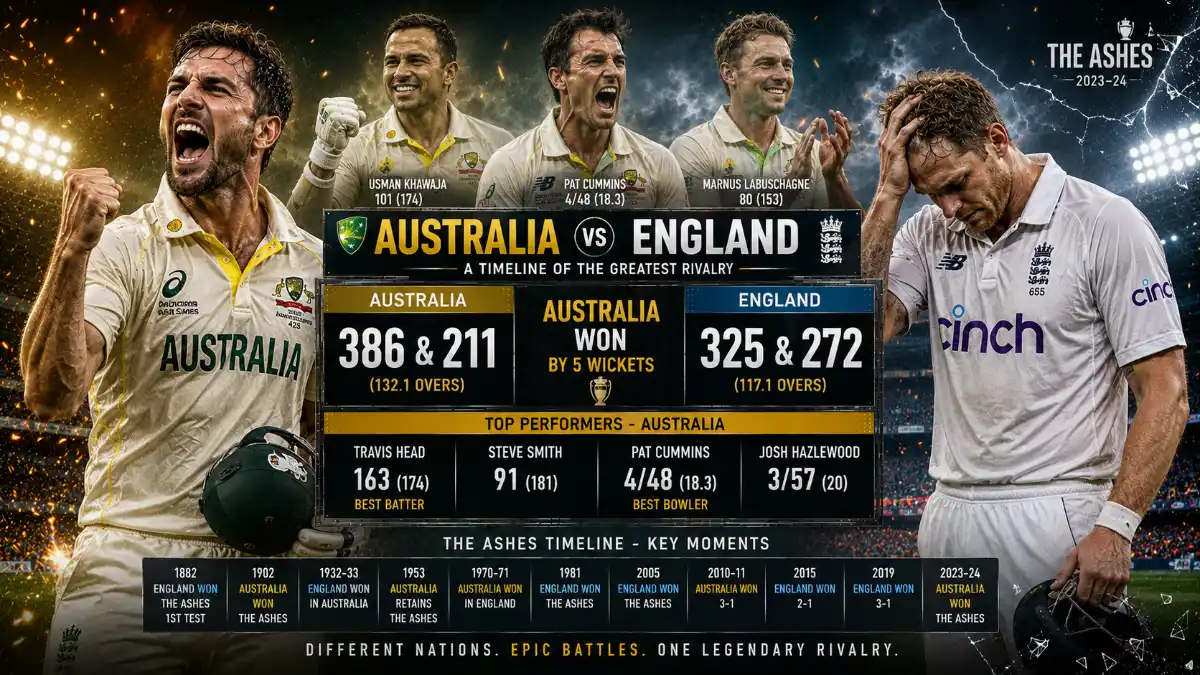
| 5th Test | SCG, Sydney | Jan 4-8, 2026 | Australia won by 5 wickets |
Australia’s bowling attack dictated terms across the series, particularly in the day-night Gabba Test where they secured victory inside a single day’s play equivalent, underlining just how conditions-dependent this rivalry remains even in its 149th year. England’s sole win at the MCG on Boxing Day briefly threatened a comeback narrative, but Australia closed out the series comfortably in Sydney to retain the urn with a game to spare.
Why This Series Result Matters
This 4-1 scoreline extended Australia’s dominant home record in the fixture and pushed their overall series lead further ahead of England heading into the next World Test Championship cycle. For England, the away-form problem that has plagued them for over a decade remains unresolved, and it raises real questions about their bowling depth on fast, bouncy Australian surfaces.
How Do Australia And England Compare In Limited-Overs Cricket?
Beyond Tests, Australia also holds a clear head-to-head advantage in ODI and T20I cricket, having won 150 of 260 ODIs and 84 of 152 T20Is against England.
ODI Head-To-Head Record
Australia and England were both present at the birth of One Day International cricket in 1971, making their limited-overs rivalry almost as historic as the Test contest itself. Australia has consistently held the upper hand in ODIs, winning 150 matches compared to England’s 110, a gap built largely on Australia’s dominant World Cup campaigns through the 1990s and 2000s.
However, this dominance hasn’t been constant – England enjoyed a strong run of 10 wins in 11 meetings following the 2015 World Cup, driven by their aggressive, high-scoring “Bazball”-style white-ball revolution under Eoin Morgan.
T20I And World Cup Encounters
In T20 internationals, Australia leads 84 wins to England’s 63 from 152 matches, though several high-stakes clashes have gone England’s way, including their 2010 ICC World Twenty20 final win in Barbados – England’s first-ever global T20 title. More recently, results have swung back toward Australia, who beat England in both the 2024 T20 World Cup and the 2025 ICC Champions Trophy, the latter featuring a standout maiden ODI century from Josh Inglis in a record run chase.
Australia vs England: Complete Format-Wise Head-To-Head
| Format | Matches Played | Australia Wins | England Wins | Draws/Other |
| Test (Ashes) | 76 series since 1882 | 34 series | 32 series | 7 drawn |
| ODI | 260 | 150 | 110 | – |
| T20I | 152 | 84 | 63 | 5 |
This table makes clear why Australia is generally viewed as the historically stronger side across all three formats, even though England has produced several individually iconic moments and series wins along the way.
Why Does This Rivalry Remain Cricket’s Biggest Contest?
The Australia-England cricket rivalry endures because it combines the sport’s longest unbroken history with genuinely fluctuating competitive balance, ensuring no single era of dominance has lasted forever.
Unlike some long-running sporting rivalries where one side pulls away permanently, this fixture has repeatedly self-corrected – England’s 1882-88 dominance gave way to Bradman’s Australia, which eventually yielded to England’s 1970s revival, only for Warne and McGrath to restore Australian control, before 2005 proved England could still win the biggest prizes. That pattern of momentum swinging back and forth across generations is precisely what keeps the Australian men’s cricket team vs England cricket team timeline relevant to new generations of fans rather than becoming a one-sided historical footnote.
The Role Of Individual Rivalries Within The Team Contest
Beyond team results, this fixture has produced some of the sport’s most celebrated individual duels – Bradman versus England’s bowlers in the 1930s, Botham’s all-round genius in 1981, Warne’s leg-spin mastery through the 1990s and 2000s, and more recently Steven Smith’s remarkable consistency against England’s bowling attacks. Steven Smith has scored over 3,400 runs against England at an average above 56, making him the standout modern-era batter in this rivalry and a genuine successor to the legacy Bradman established nearly a century earlier.
What This Means For Future Series
With Australia currently leading across Tests, ODIs, and T20Is, England face mounting pressure to solve their away-form issues, particularly on fast, bouncy pitches that have repeatedly troubled their batting lineups on Australian soil. The next major series in this rivalry will likely determine whether Australia’s current period of dominance extends further or whether England can engineer another Botham-esque or Flintoff-style turnaround the way they did in 1981 and 2005.
Frequently Asked Questions
What is the complete Australian men’s cricket team vs England cricket team timeline in Test cricket?
The timeline begins with the first-ever Test in 1877, formalizes into the Ashes rivalry from 1882 onward, and continues through the most recent 2025-26 series, which Australia won 4-1.
Who has won more Ashes series overall, Australia or England?
Australia leads with 34 series wins compared to England’s 32, with 7 series ending in draws.
When did the Ashes rivalry officially begin?
The Ashes name originated after the 1882 series, when a satirical newspaper obituary joked that English cricket had “died” following Australia’s first Test win on English soil.
Who holds the batting record in Ashes history?
Don Bradman holds the record with 5,208 runs at an average of 89.78 across 37 matches.
Who is the leading wicket-taker in Ashes history?
Shane Warne leads with 195 wickets from 36 matches, followed by Glenn McGrath with 157.
What was the result of the most recent Ashes series?
Australia won the 2025-26 Ashes series 4-1, winning four of the five Tests played across Perth, Brisbane, Adelaide, Melbourne, and Sydney.
How does Australia’s ODI record against England compare?
Australia leads the ODI head-to-head 150 wins to 110 from 260 matches played.
Which team leads the T20I head-to-head between Australia and England?
Australia leads with 84 wins compared to England’s 63 from 152 T20I matches.
Why has Australia dominated recent home Ashes series?
Australia’s home pitches tend to be faster and bouncier, which suits their pace-heavy bowling attacks better than England’s typically seam-friendly home conditions.
Did England ever end a long Australian winning streak in the Ashes?
Yes, England broke Australia’s eight-series winning run in 2005, winning 2-1 in a series regarded as one of the greatest in cricket history.