England Women’s National Cricket Team vs India Women’s National Cricket Team Timeline: The Complete 2026 Story
The England women’s national cricket team vs India women’s national cricket team timeline for 2026 reads like a script no one saw coming – a T20I series slipping away from India, followed by a red-ball rout so emphatic that it rewired how both camps think about their rivalry heading into a packed white-ball calendar. Between late May and mid-July 2026, these two sides played four matches across two formats, and the shift in momentum from one format to the next tells you everything about where each team’s real strength lies right now.
England Women won the three-match T20I series 2-1, but India Women responded with a colossal 270-run victory in the historic first-ever women’s Test at Lord’s, evening the psychological scoreboard heading into the rest of 2026.
This piece breaks down every match, every turning point, and the tactical reasoning behind why the result flipped so dramatically once the format changed – plus what it means for both teams’ Women’s Test cricket and T20 World Cup ambitions.
What Happened Between England Women and India Women in 2026?
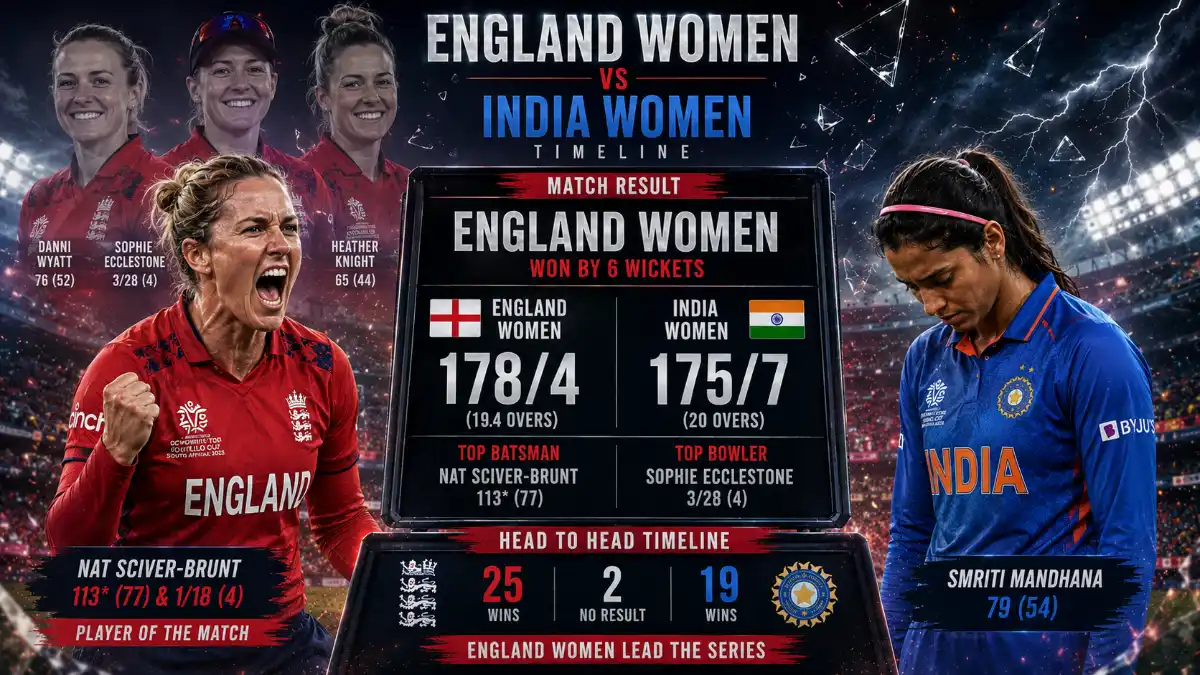
The England Women vs India Women 2026 series consisted of three T20 Internationals played in late May and early June, followed by a landmark one-off Test at Lord’s in July. England took the shorter format 2-1, riding a strong finish from Alice Capsey and Heather Knight, while India dominated the Test with a batting masterclass and a spin-bowling demolition that left England chasing an impossible target.
In short: England = white-ball series winners. India = Test cricket statement-makers. Both results carried weight beyond the scoreboard, feeding directly into World Cup preparation and long-term format planning for both camps.
Series Snapshot
- Format: 3 T20Is + 1 Test (no ODIs played in this particular window)
- T20I result: England Women won 2-1
- Test result: India Women won by 270 runs
- Historic note: The Lord’s fixture was the first-ever women’s Test match played at the venue
- World Cup context: The T20I series doubled as final preparation before the ICC Women’s T20 World Cup
T20I Series: How England Clawed Their Way Back
India won the opening T20I by 38 runs, England leveled the series in Bristol, and then sealed a series-clinching six-wicket win in Taunton to finish 2-1.
The three-match T20I series was tightly fought, and each game had a distinct tactical story. India’s death-overs batting weakness – a problem that had quietly built over the past year – became the central talking point by the time the series wrapped up.
1st T20I, Chelmsford: India Draw First Blood
India Women opened the tour with a comfortable 38-run win. Jemimah Rodrigues top-scored with a fluent 69, ably supported by Yastika Bhatia’s 54, giving India a platform well beyond 170. On debut, Nandani Sharma picked up three wickets to unsettle England’s middle order and confirm India’s control of the game from the powerplay onward.
The tactical takeaway here was simple: India’s top three functioning together, plus a debutant seamer delivering under pressure, is a formula that works. It just wasn’t sustainable across the whole series.
2nd T20I, Bristol: England Level Through Freya Kemp
England responded immediately. Freya Kemp produced the standout individual performance of the series – an unbeaten 39 off just 13 balls with the bat, followed by figures of 2-15 with the ball to restrict India to 142-9 in defense of 169. This was the match where England’s finishing power and all-round depth first became visible as a genuine point of difference.
Charlie Dean’s timely wickets in the middle overs also disrupted India’s rhythm at a stage when the chase still looked gettable, turning a competitive chase into a defeat by 26 runs.
3rd T20I, Taunton: Capsey and Knight Seal the Series
The decider went England’s way emphatically. Alice Capsey smashed 82, and stand-in captain Heather Knight blazed an unbeaten 70 off just 42 balls – England’s fastest-ever T20I half-century – to chase down 180 with nine balls in hand. India’s Harmanpreet Kaur had given the innings late impetus with an unbeaten 56, but it wasn’t enough against a chase that never lost momentum.
This game exposed India’s recurring soft spot: a lack of depth and finishing power in the batting order once the top three were removed, a pattern that carried real significance heading into the T20 World Cup.
Key stat: England’s batting struck at over 9 runs per over in the death overs across the series – a clear tactical edge that India’s bowling attack couldn’t neutralize.
The Historic Lord’s Test: India’s Statement Win
India Women beat England Women by 270 runs in the first-ever women’s Test staged at Lord’s, played July 10-13, 2026 – one of the largest winning margins by runs in the history of women’s Test cricket.
If the T20Is highlighted India’s fragility, the Test match flipped the narrative entirely. This wasn’t a close contest – it was a complete tactical and skill mismatch once India built their first-innings lead, and it instantly became one of the most talked-about results in women’s Test cricket history.
Read More: England Women’s National Cricket Team vs India Women’s National Cricket Team Timeline
First Innings: Mandhana and Harmanpreet Lay the Platform
India batted first and posted 285, built around a composed 83 from Smriti Mandhana and a gritty 58 from Harmanpreet Kaur. The pitch offered turn from early on, but India’s top order handled the conditions far better than England anticipated, setting up everything that followed.
England’s reply collapsed to just 170, undone by Kranti Gaud’s career-best figures of 5-37. Her ability to extract seam movement on a spin-friendly surface caught England’s batters completely off guard – a genuinely underrated tactical wrinkle in this Test.
Second Innings: Bhatia’s Century Buries England
India’s second innings turned the contest from competitive into one-sided. Yastika Bhatia compiled a magnificent 113, and Mandhana added another fluent 70, pushing India’s total to 341 for 7 declared. That left England chasing an almost unheard-of target of 457 to win.
Important context: A target north of 450 in a women’s Test is exceptionally rare – most Tests in the format don’t reach three full innings’ worth of scoring, which underlines just how dominant India’s batting had become by this stage.
Why England’s Chase Collapsed
England’s chase fell apart because India’s spin attack – led by Sneh Rana and Deepti Sharma – exploited a deteriorating pitch on days three and four, dismantling the middle and lower order before England could build any resistance.
Sneh Rana finished with 4-42, repeatedly targeting the stumps and trapping batters on the crease, while Deepti Sharma chipped in with 2-36 to squeeze the innings from the other end. England’s only real fight came from Sophie Ecclestone, who defied the collapse with a maiden Test half-century of 50 before eventually being bowled by Rana – the wicket that effectively confirmed the result.
India completed the win inside 95 minutes on the final morning, sealing a 270-run margin – the fourth-highest winning margin by runs in the history of women’s Test cricket. The match also carried an emotional subplot: it marked the final Test appearance of veteran England opener Tammy Beaumont, closing out a 17-year international career at the same venue where the sport’s newest Test tradition began.
Tactical Breakdown: Why India’s Bowling Plan Worked
- Spin-seam combination: Gaud’s seam movement in the first innings and Rana/Deepti’s spin control in the second gave India two distinct threats England never adjusted to.
- Pitch reading: India’s captaincy decisions around field placements – tighter catching cordons for the spinners once cracks widened – squeezed scoring options.
- Batting depth: Bhatia’s century in the second innings, batting outside her usual top-order role, gave India the cushion to declare aggressively and still have time to bowl England out twice.
- Pressure application: England never found a partnership of substance in either innings, and the lack of a settled middle-order pairing compounded the pressure from India’s bowlers.
England Women vs India Women 2026 Series Timeline
| Match | Venue | Date | Result |
| 1st T20I | Chelmsford | May 28 | India won by 38 runs |
| 2nd T20I | Bristol | May 30 | England won by 26 runs |
| 3rd T20I | Taunton | June 2 | England won by 6 wickets |
| Only Test | Lord’s, London | July 10-13 | India won by 270 runs |
Series scoreline summary: England Women 2-1 (T20Is), India Women 1-0 (Test)
Head-to-Head Context: A Rivalry Tilted Toward England Overall
England Women hold a narrow historical edge over India Women with 66 wins from 129 total meetings across formats, though India’s Test record in England remains notably strong.
Looking at the broader rivalry, England’s overall win percentage sits higher than India’s, largely due to superior depth in ODIs, where England leads 39-31 across 72 meetings, including a 7-4 advantage specifically in Women’s World Cup fixtures. But India’s red-ball form on English soil tells a different story – the Lord’s win extended India’s strong recent Test record in England, reinforcing that format matters enormously when assessing this rivalry.
Why Format Matters So Much in This Rivalry
- T20Is: England’s power-hitting depth (Capsey, Knight, Kemp) consistently creates matchup problems for India’s middle order.
- ODIs: England’s historical dominance stems from more balanced top-to-bottom batting over 50 overs.
- Tests: India’s spin quartet and improved seam options have flipped the balance in the format’s rarer, longer contests.
This split explains why neither side can be called the outright stronger team right now – it genuinely depends on which format is being played.
What This Means Going Forward
The T20I series loss stung briefly, but the Lord’s Test triumph reset the psychological balance heading into future fixtures between these two sides. India’s spin depth and top-order batting form now stand out as the format’s biggest differentiator, while England’s white-ball finishing power remains a genuine threat in shorter formats. Both teams head into the rest of 2026 with clear tactical templates to build on – and clear weaknesses to fix – making the next meeting between these sides one of the more closely watched fixtures on the women’s international cricket calendar.
Frequently Asked Questions
Who won the England Women vs India Women series in 2026?
England Women won the three-match T20I series 2-1, while India Women won the one-off Test by 270 runs.
Where was the historic England vs India women’s Test played?
The Test was played at Lord’s Cricket Ground in London, marking the first-ever women’s Test staged at the venue.
What was the final result of the Lord’s Test between England and India Women?
India Women won by 270 runs, one of the largest winning margins by runs in women’s Test cricket history.
Who was the standout performer in the Lord’s Test?
Yastika Bhatia’s 113 in the second innings and Sneh Rana’s 4-42withn the bowling were the standout individual performances for India.
Why did England’s chase collapse in the second innings at Lord’s?
England’s batting order couldn’t cope with India’s spin attack once the pitch started deteriorating, and only Sophie Ecclestone’s defiant half-century offered any real resistance.
How many T20Is were played between England and India Women in 2026?
Three T20Is were played – in Chelmsford, Bristol, and Taunton – with England winning the series 2-1.
Who won the decisive third T20I in Taunton?
England Women won by six wickets, chasing 180 with Alice Capsey (82) and Heather Knight (70 not out) leading the run chase.
What is the overall head-to-head record between England and India Women?
England Women have won 66 of 129 total meetings across all formats, giving them a narrow historical edge over India.
Was this Tammy Beaumont’s last Test for England?
Yes, the Lord’s Test marked the final appearance of Tammy Beaumont’s 17-year England career.
What does this series mean for the upcoming T20 World Cup?
The T20I series functioned as final preparation for both sides, exposing India’s death-overs batting depth as a concern while confirming England’s finishing strength as a key advantage heading into the tournament.