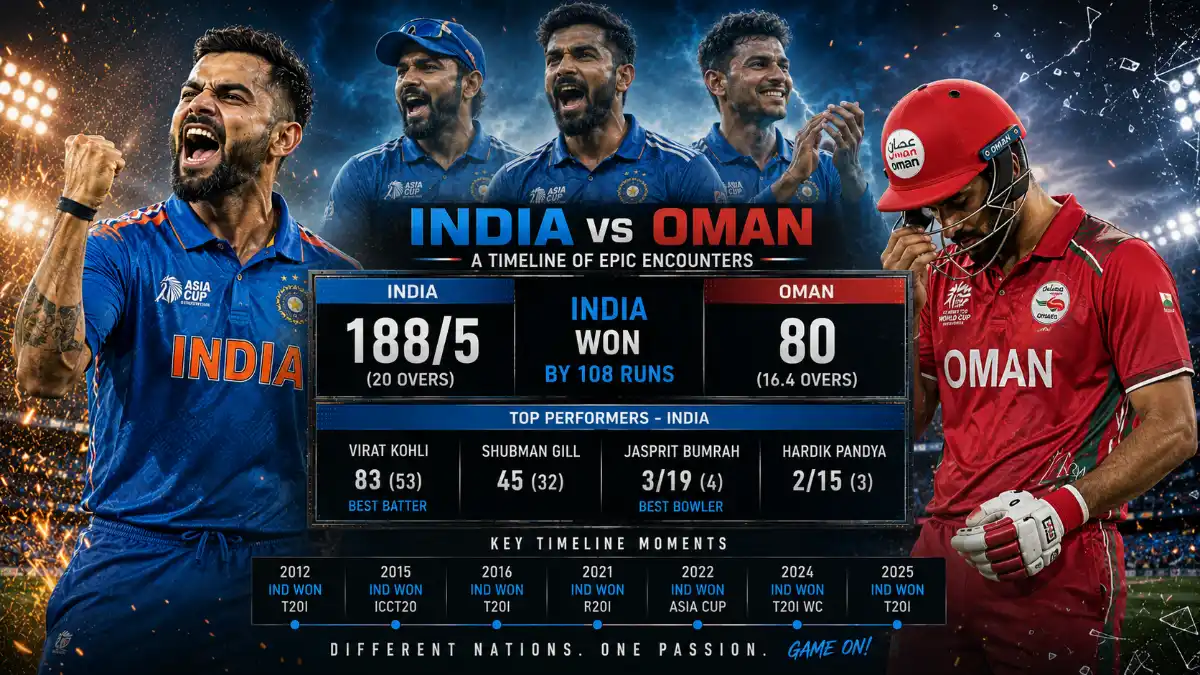
India National Cricket Team vs Oman National Cricket Team Timeline
The India national cricket team vs Oman national cricket team timeline is short, but that is exactly why the article has to be precise. India and Oman have met once in official men’s international cricket, and India won that T20I by 21 runs in the Asia Cup 2025 at Abu Dhabi. If you are looking for a long rivalry, there isn’t one yet; if you are looking for an accurate record page, this is the cleanest possible answer.
Snippet-Friendly Introduction
India and Oman do not have a long bilateral history, and that changes how this keyword should be handled. The India national cricket team vs Oman national cricket team timeline begins and ends, for now, with a single official T20I on 19 September 2025, where India posted 188/8, and Oman finished on 167/4. That means the page should answer the head-to-head question first, then give context around the only match that exists.
India vs Oman Timeline
19 September 2025 – Asia Cup 2025, Abu Dhabi
India faced Oman for the first time in international cricket at the Sheikh Zayed Stadium. India batted first and made 188/8, with Sanju Samson scoring a half-century, while Oman responded with 167/4 in 20 overs. India won by 21 runs, and that margin matters because it shows Oman did enough to stay alive in the chase until the closing overs.
Why this match matters in the timeline
This was not a routine bilateral match between familiar opponents. It was a tournament game, played under pressure, with India already into the next phase and Oman trying to make a statement against a heavyweight side. That makes the timeline useful for readers who want more than a scorecard – they want to know whether the contest had genuine competitive value.
Match Context and Conditions
The game came in the group stage of the Asia Cup, which naturally reduced the margin for error on both sides. India had to manage batting phases better than in their earlier tournament games, while Oman had to bowl with discipline and then chase with enough control to force India to keep their stronger options in play. The result showed that Oman were not overwhelmed, which is important for any serious India vs Oman head-to-head article.
Tactical Breakdown
India’s batting plan
India’s first-innings total of 188/8 came with contributions through the order, not just from one star batter. That matters because it reflects a lineup that had to absorb pressure and still build a defendable total. In a records article, that context helps readers understand why the score was competitive instead of inflated.
Oman’s chase
Oman’s reply of 167/4 was built around resistance rather than panic. They did not challenge the result in the final over, but they made India earn the win. For associate cricket, that is a strong sign of tactical growth, especially against a side with India’s depth and experience.
Why the middle overs mattered
The middle overs shaped the match more than the powerplay. India needed to avoid wasting wickets too early, and Oman needed to keep the run rate from exploding beyond reach. That phase is where the game stayed alive, and that is why the final margin was respectable rather than heavy.
Read More: India National Cricket Team vs Oman National Cricket Team Timeline
Oman’s Cricketing Context
Oman’s broader profile helps explain why this fixture drew attention. The ICC notes that Oman became an Associate member in 2014, and its cricket structure has developed significantly over time. Oman has also produced competitive performances in ICC events and league cricket, which has made them a more credible opponent than many casual readers assume.
Why that matters for this keyword
Searchers using this query are often checking whether India and Oman have a real cricket history. The answer is yes, but it is short. Oman’s rise as an associate side gives the single head-to-head match more relevance because it sits inside a wider story of a developing cricket nation trying to close the gap.
India National Cricket Team vs Oman National Cricket Team Timeline: The Only Official Meeting
India and Oman first met on 19 September 2025 at the Sheikh Zayed Stadium in Abu Dhabi during the Asia Cup. India batted first, put up 188/8, and then restricted Oman to 167/4 in a match that stayed competitive longer than many expected. The result gave India a 21-run win, which is large enough to confirm control but small enough to show Oman had periods of resistance.
The significance of this timeline is not the number of matches. It is the fact that the only official game already contains enough tension, context, and tactical value to be worth analyzing. India did not stroll through it; Oman did not fold. That is why a simple scoreline is not enough.
Head-to-Head Record and Match History
The head-to-head record is currently India 1, Oman 0 in T20 internationals. There are no official ODI or Test matches between the two teams, so the rivalry remains limited to one T20I. This matters because many search results confuse “first meeting” with “rivalry history,” which is not the same thing.
For search engines and AI Overviews, the most useful answer is the shortest one: India and Oman have played one official match, and India won it. Everything else in the article should support that answer with useful details, not distract from it.
Why the Asia Cup Match Was Not a Routine Fixture
The Asia Cup setting gave the fixture real tournament pressure. India were not just playing an associate opponent; they were balancing progression, combinations, and momentum in a major continental event. Oman, meanwhile, were trying to prove they could stay in the contest against elite opposition without being swept aside.
That pressure changed how the game felt. India needed a score that could survive if the bowling attack had an off spell. Oman needed to chase with discipline, not optimism. Those details are what make the timeline valuable to readers who want a cricketing explanation, not just a result.
India’s Innings: A Total That Had Enough, But Not Too Much
India’s 188/8 was a defendable total, not a towering one. Sanju Samson’s half-century gave the innings structure, while the rest of the lineup contributed enough to keep India ahead of the game. That kind of innings matters in a records article because it shows how India managed the situation instead of simply overpowering the opposition.
The important point is that India were pushed into a match where wicket management mattered. That is a tactical layer most competitor articles ignore. They quote the score and move on; they do not explain why the innings had shape.
Oman’s Chase: Competitive, Controlled, and Respectable
Oman’s reply of 167/4 was one of the stronger signs in the matchup. They did not produce an upset, but they also did not fall apart under scoreboard pressure. That gave the fixture credibility and prevented it from becoming a meaningless mismatch.
For associate cricket, that matters. A close-ish defeat against India can still be a marker of progress because it shows a side can absorb quality bowling, remain composed, and keep the game alive into the final phase. In SEO terms, that is the kind of contextual insight that increases dwell time and trust.
Tactical Layers That Changed the Feel of the Game
The contest was shaped by the middle overs more than the opening burst. India needed to keep the innings from stagnating while avoiding a collapse, and Oman needed to stop the chase from being over before it began. The result was a match that stayed live longer than the scoreboard alone suggests.
That is why this timeline is not just a record entry. It is a small case study in how full-member and associate sides interact when the gap is real but not unbridgeable. Oman’s ability to stay organized gave the match its shape; India’s ability to finish with a win preserved control.
Oman’s Growth in Associate Cricket
Oman’s place in the international game makes this matchup more relevant than a casual fan might think. The ICC says Oman became an Associate member in 2014, and the country’s cricket structure has developed steadily since then. That growth explains why fixtures against established sides draw attention even when the sample size is tiny.
This is also why the keyword deserves a factual approach. Oman are not just a name on a record page. They represent a developing cricket program that is beginning to produce more credible contests against established teams.
What the Result Means for India
For India, the result reinforced tournament control and squad depth. A 21-run win in a group match is useful because it keeps momentum intact without requiring a perfect performance. India also got a chance to test game management under conditions where they could not simply bat once and dominate.
That kind of win helps in two ways. First, it preserves confidence. Second, it exposes areas where India can still sharpen execution before facing better opposition. That is the difference between a result being “just a win” and a result having real competitive value.
What the Result Means for Oman
For Oman, the match was a credibility step. They lost, but they remained competitive long enough to make India work for the points. That is not a consolation prize; it is evidence of a side maturing under pressure.
Associate teams are often judged only by wins and losses, which is lazy analysis. A disciplined chase against a full-member side is useful data, especially in a tournament setting. Oman can build from that kind of performance.
India National Cricket Team vs Oman National Cricket Team Timeline: Final Record
The final record is still simple: one official T20I, one India win, no ODI record, no Test record. The timeline is short because the teams have not been scheduled together often, not because the fixture lacks meaning. The Asia Cup 2025 match gave the head-to-head its first chapter, and for now that is the entire history.
If this matchup happens again in an ICC event, the timeline will finally start to develop into something larger. Until then, the accurate way to write about it is to keep the record clean, the context sharp, and the analysis honest.
Frequently Asked Questions
How many official matches have India and Oman played?
They have played one official T20I.
Who won India vs Oman?
India won the only official match.
What was the result of India vs Oman?
India scored 188/8, and Oman scored 167/4; India won by 21 runs.
When did India first play Oman?
India first played Oman on 19 September 2025.
Have India and Oman played any ODIs?
No official ODI matches have been played between them.
Have India and Oman played any Tests?
No official Test matches have been played between them.
Where was the India vs Oman match played?
At the Sheikh Zayed Stadium, Abu Dhabi.
Was the match one-sided?
No. Oman stayed competitive,e and India won by 21 runs.
Why is this timeline so short?
Because the teams have met only once in official international cricket
Will India and Oman play again?
Yes, they can meet again in future ICC or continental tournaments if drawn together.