
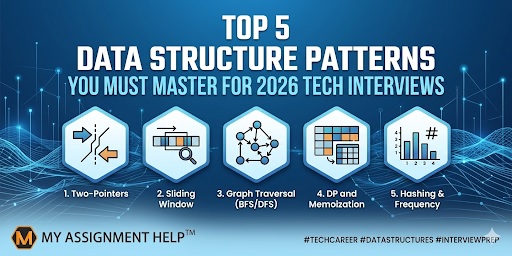
Top 5 Data Structure Patterns You Must Master for 2026 Tech Interviews
As we move into 2026, the landscape of technical interviews at Tier-1 tech companies—ranging from OpenAI and NVIDIA to the traditional FAANG stalwarts—has shifted. While foundational knowledge remains critical, interviewers are increasingly focusing on a candidate’s ability to recognize underlying patterns rather than just memorizing specific LeetCode solutions.
With the integration of AI-assisted coding tools, the bar for “functional” coding has risen. Candidates are now evaluated on their architectural intuition and their ability to optimize space-time complexity in distributed environments. Mastering data structure patterns allows you to categorize almost any problem into a known methodology, significantly reducing the “panic time” during a live 45-minute coding session.
Navigating these complex academic and professional requirements can be taxing for students and career-switchers alike. Many find that seeking professional assignment writing help allows them to balance their rigorous coursework with the deep-dive practice needed for technical interview prep. By offloading the structural documentation of their projects, candidates can focus entirely on mastering the algorithmic logic required for the 2026 recruitment cycle.
Below, we break down the five most influential patterns that are currently dominating the 2026 interview circuit.
1. The Sliding Window (Dynamic & Fixed)
The Sliding Window pattern remains the gold standard for problems involving arrays or linked lists where you need to find a subset of data that meets certain criteria. In 2026, we are seeing a surge in “Variable-sized Sliding Window” problems, which are often used to simulate real-time data streaming and buffer management.
- When to use: Longest/Shortest substring, subarray sums, or tracking distinct elements within a range.
- 2026 Trend: Interviewers are pairing this with “Hysteresis” logic to simulate how modern load balancers handle fluctuating traffic.
- Complexity: Generally reduces $O(N^2)$ brute-force solutions to a crisp $O(N)$.
2. Modified Binary Search
While basic Binary Search is entry-level, the “Modified” version is a staple for Senior Engineer interviews. This involves searching in “Nearly Sorted” arrays, finding the “Peak Element” in a mountain array, or searching in a rotated sorted array.
Because efficiency is paramount in high-frequency trading and AI model indexing, being able to implement a logarithmic search in a non-standard data set is a high-signal trait for recruiters. If you find yourself struggling with the mathematical proofs behind these algorithms, specialized data structure assignment help can provide the step-by-step breakdown needed to internalize these concepts for your exams and interviews.
3. Two Pointers (The Squeeze & The Chase)
The Two Pointers pattern involves two indices moving through the data structure at different speeds or in different directions.
- The Squeeze: Pointers start at opposite ends and move toward the center (e.g., Valid Palindrome, 3Sum).
- The Chase (Fast & Slow): Also known as “Floyd’s Cycle-Finding Algorithm,” this is essential for detecting cycles in linked lists or finding the middle element.
4. Top ‘K’ Elements (Heap Pattern)
Any problem asking for the “Top K,” “Frequent K,” or “Closest K” elements should immediately trigger the Heap pattern. Utilizing a Min-Heap or Max-Heap allows you to keep track of elements in $O(N \log K)$ time instead of $O(N \log N)$. In an era of Big Data, the difference between $N \log N$ and $N \log K$ is the difference between a system that scales and one that crashes.
5. Monotonic Stack
This is the “dark horse” of 2026 interviews. A monotonic stack is a stack where elements are always in increasing or decreasing order. It is the most efficient way to solve “Next Greater Element” or “Daily Temperatures” problems. It is particularly relevant for UI/UX rendering engines and timeline-based data processing.
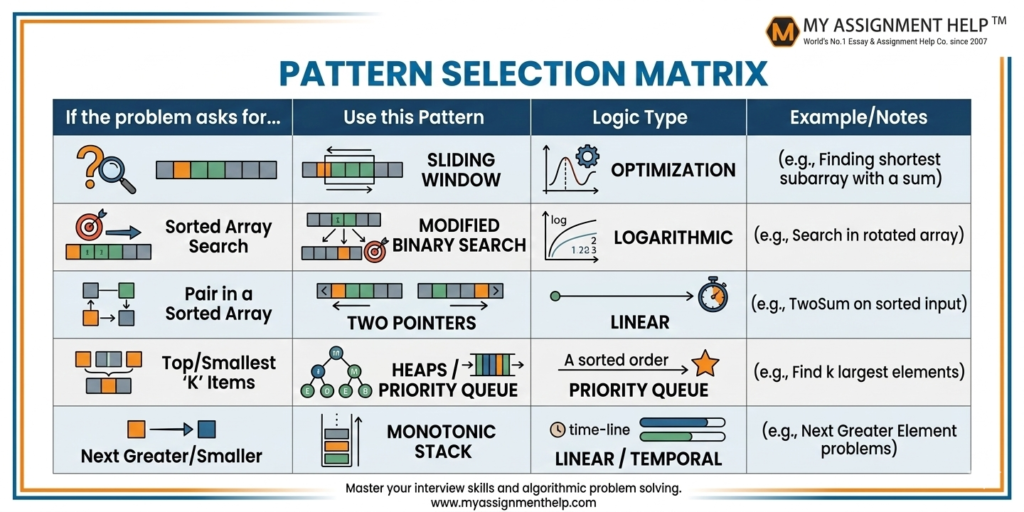
Data-Driven Insights: Why Patterns Matter
According to 2025-2026 recruitment data from HackerRank and CodeSignal, candidates who apply a recognized pattern within the first 10 minutes of an interview have an 82% higher pass rate than those who attempt to “invent” a solution from scratch. Furthermore, the Bureau of Labor Statistics continues to project a 25% growth in software roles through 2032, but with a caveat: the competition for “Entry Level” has intensified, making pattern mastery a mandatory baseline rather than an elective skill.
Key Takeaways
- Stop Memorizing, Start Categorizing: Every LeetCode “Hard” is usually just two “Easy” patterns stitched together.
- Complexity First: Always state your Big O complexity before you write a single line of code.
- Visualizing the Data: 2026 interviews value candidates who can draw out the “state” of their data structure at each iteration.
Frequently Asked Questions (FAQs)
Q1: Why is the Sliding Window better than a nested loop?
Nested loops often result in $O(N^2)$ complexity because you re-scan elements multiple times. Sliding Window ensures each element is visited at most twice (once by the ‘start’ pointer and once by the ‘end’), resulting in $O(N)$.
Q2: Should I learn these in Python, Java, or C++?
For interviews, Python is generally preferred for its concise syntax, which allows you to focus on the logic. However, if you are applying for Systems Engineering, C++ is expected for its manual memory management.
Q3: How do I identify a Monotonic Stack problem?
Look for “Range Queries” or “Next/Previous” element requirements where the relative order of elements must be preserved while comparing values.