

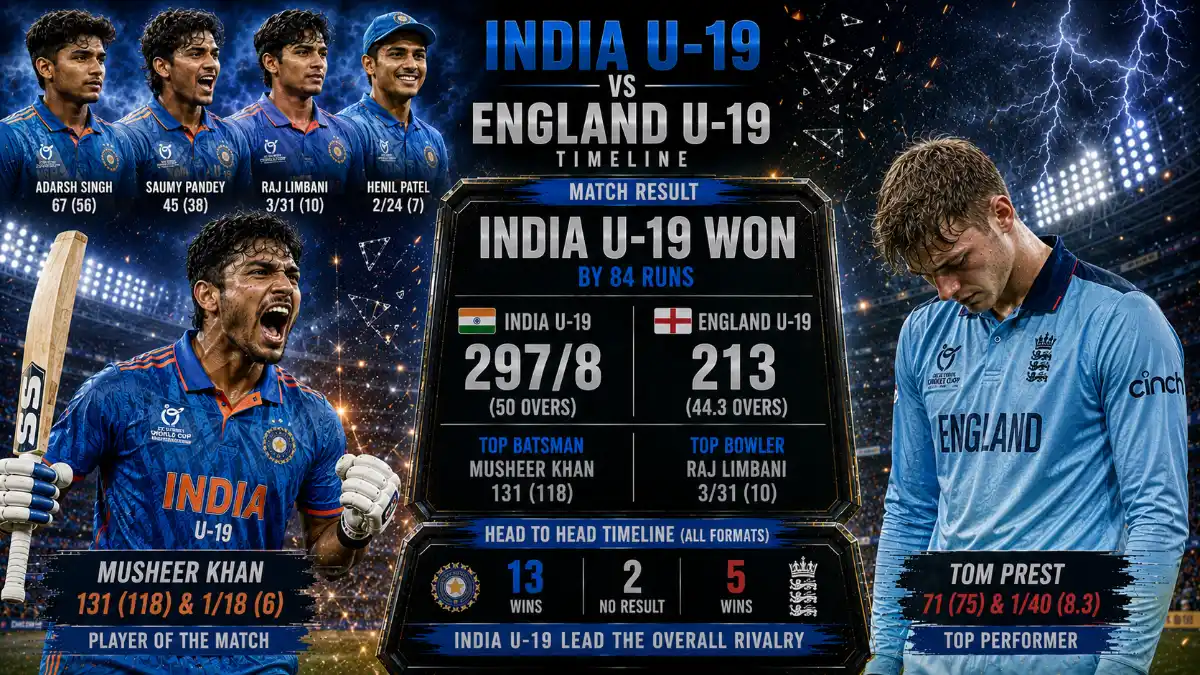
The India national under-19 cricket team vs England under-19 cricket team timeline stretches back to 1981, and India currently leads the all-format head-to-head 40 wins to 13, including a perfect 2-0 record in U19 World Cup final meetings (2022 and 2026). This dominance isn’t accidental – it reflects two very different age-group cricket ecosystems colliding repeatedly on the biggest junior stage in the sport.
India’s junior pathway, built around zonal trials, the Cooch Behar Trophy, and BCCI-run age-group camps, has produced a conveyor belt of players who transition almost seamlessly into IPL scouting and senior selection. England’s Under-19 setup, rooted in county academies and the England Cricket Board’s pathway programs, has historically produced technically sound players who compete well in bilateral cricket but have struggled to convert that competitiveness into knockout wins against India. That gap – competitive in bilateral series, outmatched in World Cup finals – is the defining thread of this rivalry, and it’s the part most match reports skip entirely.
How the India U19 vs England U19 Rivalry Began
The first recorded meeting between India Under-19s and England Under-19s took place in 1981 during India’s tour of England, with a young Ravi Shastri leading the Indian side against Tim Boon’s England unit. India were bowled out for a modest 98 in the second fixture at Cambridge, a scoreline that set an early tone of England holding the upper hand in the formative years of this bilateral relationship.
Early Bilateral Series and the First Power Shift
England actually won the earliest structured bilateral series against India, taking the honors in the 1992-93 cycle on home soil. India responded almost immediately, sweeping England 3-0 during the corresponding home leg that same season. This back-and-forth pattern – England competitive at home, India dominant on Indian pitches – became a recurring subplot long before either side prioritized the tournament that would eventually define their rivalry: the ICC Under-19 World Cup.
Why India’s Pipeline Pulled Ahead
By the late 1980s and through the 1990s, India’s domestic age-group structure began producing depth that England’s county-based system couldn’t consistently match. India’s advantage wasn’t raw talent alone – it was volume and repetition, with far more structured junior fixtures feeding into national selection than England’s regional pathway offered at the time. This structural gap widened through the 2000s as India’s junior cricket calendar expanded alongside the rise of domestic T20 scouting, giving young Indian players exposure to higher-pressure situations earlier in their development.
World Cup Knockout History Between India and England
India and England have met eight times at the Under-19 World Cup dating back to 1988, and India has won six of those meetings, including both occasions the two sides have reached a final together. This knockout record is where the rivalry’s real weight lives, because bilateral form has repeatedly failed to predict World Cup outcomes.
The 2022 Final: India’s First Win Over England on the Biggest Stage
Before 2026, India and England had already faced off seven times at the World Cup without meeting in a final. That changed in 2022 at the Sir Vivian Richards Stadium, where Yash Dhull’s India side edged past England in a tense chase to lift a record-extending fifth title. The 2022 final proved that England’s improved bilateral form throughout that tournament cycle still couldn’t translate into a knockout win against India when the stakes were highest.
Tactical Pattern: England Competes, India Closes
A clear tactical pattern emerges across these knockout meetings – England’s bowlers typically execute early plans well, keeping India’s top order under control for extended periods, but India’s middle-to-late order depth consistently finds a way to break open tight contests. England’s batting, by contrast, tends to start steadily but loses composure once required run rates climb past manageable thresholds in the back half of an innings.
Inside the 2026 U19 World Cup Final: India’s Record Sixth Title
India Under-19s defeated England Under-19s by 100 runs at Harare Sports Club on February 6, 2026, winning a record sixth Under-19 World Cup title behind a scintillating 175 off 80 balls from Vaibhav Suryavanshi. The margin made it the second-most one-sided U19 World Cup final in the tournament’s history, and the numbers only tell part of the story.
The Toss Decision That Shaped Everything
Captain Ayush Mhatre won the toss and chose to bat first on a Harare surface known for rewarding sides that post totals early rather than chase under lights. This single tactical call took away England’s preferred method throughout the tournament, where captain Thomas Rew’s side had built a habit of chasing down totals with calm, measured batting through the middle overs. By forcing England to bowl first and then chase a mountain, India neutralized the exact scenario England’s bowling attack and batting order were most comfortable executing.
Read More: India National Under-19 Cricket Team vs England Under-19 Cricket Team Timeline
The Innings That Broke England’s Bowling Plans
Suryavanshi’s 175 off 80 deliveries wasn’t just a personal landmark – it dismantled England’s bowling strategy inside the first 25 overs. His strike rate of over 218 forced England’s captain into defensive field settings far earlier than the bowling group had trained for during the tournament, and once that plan collapsed, India’s innings accelerated into repeated boundary clusters rather than measured accumulation. India finished at 411 for 9 in 50 overs, a total built on sustained aggression rather than steady partnership-building, which left England’s new-ball bowlers with no reliable data to fall back on for their death-overs execution.
India U19 Batting Highlights (2026 Final)
- Total posted: 411/9 in 50 overs
- Standout innings: Vaibhav Suryavanshi, 175 off 80 balls
- Strike rate: Over 218, among the fastest in U19 World Cup final history
- Captaincy call: Won the toss, elected to bat first
England’s Chase: Genuine Intent, Compounding Pressure
England’s reply of 311 all out was actually their joint-highest total in a U19 World Cup final, reflecting real batting intent rather than a straightforward capitulation. The problem wasn’t application – it was mathematics: once the required run rate climbed past nine runs per over by the 30th over, risk-taking stopped being a choice and became mandatory. Losing three wickets for just three runs in seven balls during the death overs turned a respectable, fighting chase into a heavy defeat, a collapse pattern typical of young batting units facing compounding required-rate pressure rather than a pure skill gap.
Why the Margin Doesn’t Tell the Full Story
A 100-run margin suggests a mismatch, but England’s total of 311 shows this wasn’t a one-sided contest until the final ten overs. The real turning point wasn’t a single wicket or over – it was the cumulative psychological weight of chasing 412 against a bowling attack that had already dictated terms with the bat for 50 overs.
Bilateral Form vs World Cup Form: The Real Story Behind the Numbers
England Under-19s have actually been competitive in recent bilateral Youth ODIs against India, winning two of the last five head-to-head matches played in mid-2025, yet that form has consistently failed to carry over into World Cup knockout stages. This is the part of the India national under-19 cricket team vs England under-19 cricket team timeline that most coverage overlooks entirely.
Recent Head-to-Head Results
The bilateral series played across Worcester, Northampton, and Hove in June and July 2025 was split almost evenly, with England winning by seven wickets and by a single wicket in two of five matches, while India claimed the other three through varying margins. This near-even bilateral split makes India’s perfect record in World Cup finals even more significant, because it rules out any argument that India simply has better players on paper – the gap shows up specifically under knockout pressure.
Why the Composure Gap Persists
England’s junior system clearly produces technically competent, competitive cricketers capable of matching India ball for ball across a bilateral series. What it hasn’t yet replicated is India’s exposure to high-stakes, globally broadcast knockout cricket at the youth level, repeated year after year through IPL-adjacent scouting camps and domestic tournaments with genuine pressure. That repeated exposure to consequence-heavy cricket appears to be the single biggest differentiator between the two systems, more than raw skill or technique.
Impact on Player Careers and the Rivalry’s Future
India’s sixth Under-19 World Cup title further cements a talent pipeline that has already produced multiple senior internationals from previous winning squads, and Suryavanshi’s final-stage form will likely accelerate expectations around his senior team trajectory. For England, the 2026 final defeat – despite a genuinely fighting total of 311 – reinforces that their bilateral improvements haven’t yet closed the composure gap in winner-takes-all matches. The next real test for this rivalry will come at the following bilateral series and the subsequent U19 World Cup cycle, where England’s new junior development investments will face their first real scrutiny against India’s established pathway.
Frequently Asked Questions
What is the overall head-to-head record between India U19 and England U19?
India Under-19s lead the rivalry with 40 wins from 55 Youth ODIs played against England Under-19s, with one match tied.
Who won the 2026 Under-19 World Cup final between India and England?
India Under-19s won the 2026 final by 100 runs at Harare Sports Club on February 6, 2026, securing a record sixth title.
Who was the standout performer in the 2026 India vs England U19 final?
Vaibhav Suryavanshi was the standout performer, scoring 175 runs off just 80 balls to power India’s total.
How many Under-19 World Cup titles has India won in total?
India has won a record six Under-19 World Cup titles, the most by any nation in the tournament’s history.
Has England ever won the Under-19 World Cup?
Yes, England has won the tournament once, and they have also finished runners-up on multiple occasions, including in 2022 and 2026.
What was India’s final total in the 2026 World Cup final against England?
India posted 411 for 9 in 50 overs, one of the highest totals ever recorded in a U19 World Cup final.
How did England perform while chasing India’s total in the 2026 final?
England were bowled out for 311, their joint-highest total in a U19 World Cup final, but still fell 100 runs short.
Have India and England met in an Under-19 World Cup final before 2026?
Yes, the two sides also met in the 2022 final, which India won to claim their fifth title at the time.
Who captained India Under-19s in the 2026 World Cup final?
Ayush Mhatre captained the India Under-19 side in the 2026 final against England.
Is India’s dominance over England U19 consistent across bilateral series too, not just World Cups?
Not entirely – England won two of the last five bilateral Youth ODIs in 2025, showing far closer competitiveness outside World Cup knockout matches compared to India’s near-perfect record in finals.