

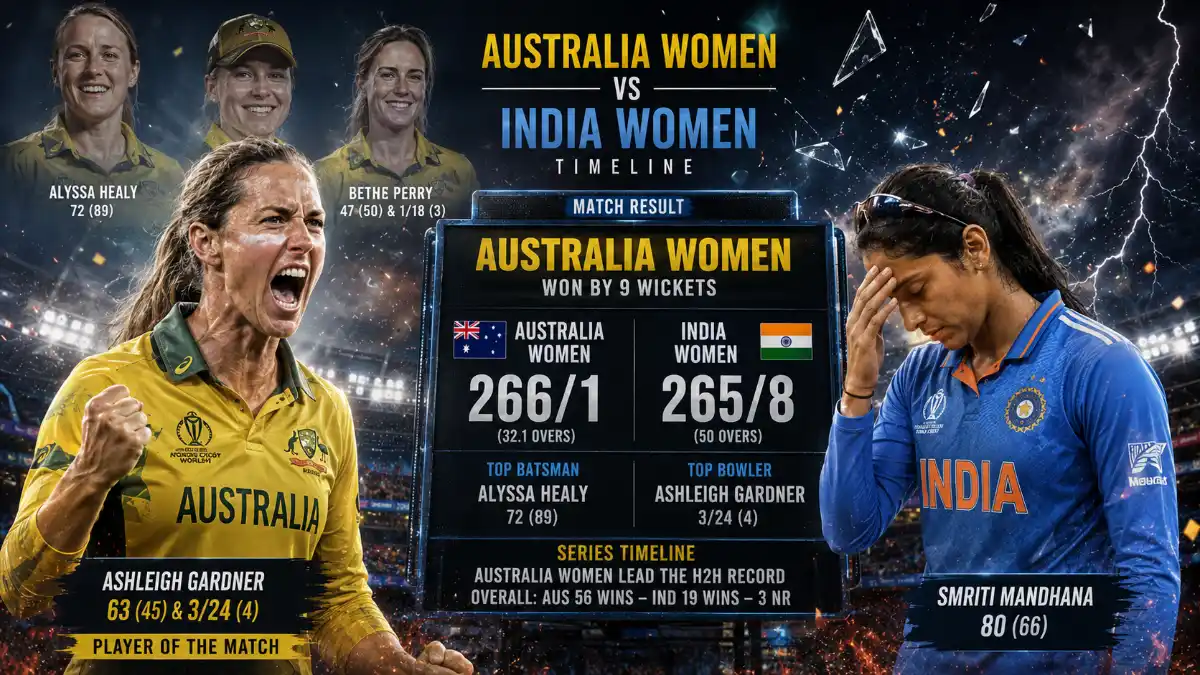
The aAustraliawomen’s national cricket team vs India women’s national cricket team timeline tells a story of one-sided dominance slowly giving way to genuine competition, culminating in a tour that reshaped how this rivalry is perceived. Australia Women lead the overall head-to-head 21 wins to 6, with 2 matches drawn or with no result across 29 meetings in all formats combined, but the numbers alone don’t capture how much the balance of power has shifted since 2023.
This rivalry has evolved from a near-mismatch into one of women’s cricket’s most closely watched contests, driven by India’s improved bowling depth, Australia’s relentless batting power, and a 2025-26 tour that delivered results across every format. Understanding the full Australia women’s national cricket team vs India women’s national cricket team timeline requires looking beyond the scoreline to the tactical shifts, key partnerships, and format-specific battles that defined each era.
Early Years: Australia’s Long-Standing ODI Dominance
Australia has won 40 of the 50 One Day Internationals played against India, with India managing only 10 victories, making the 50-over format the most lopsided chapter of this rivalry. This dominance reflects Australia’s superior fast-bowling depth and top-order batting power, an advantage India struggled to close throughout the 2000s and 2010s despite producing world-class individual talents.
The gap wasn’t just about raw skill – it was structural. Australia’s domestic system, built around the Women’s National Cricket League and later the Women’s Big Bash League, produced a conveyor belt of fast-medium seamers and power hitters years before India’s domestic women’s structure matured. India’s batting order often lacked the depth to absorb early wickets against Australia’s new-ball attack, a pattern that repeated across multiple bilateral series in this period.
Why the ODI Format Favored Australia
Australia’s dominance in ODIs specifically comes down to conditions and squad depth. Longer formats reward sustained pressure, and Australia’s bowling attacks – built around genuine pace options – consistently exposed technical gaps in India’s middle order over 40-plus overs. This structural mismatch in fast-bowling resources remained the single biggest factor behind Australia’s 40-10 ODI head-to-head lead.
Test Cricket: Rare and Rugged Encounters Between the Two Sides
Australia held a 4-0 lead with 6 draws across the first 10 Tests between the sides before December 2023, and, remarkably, none of the four matches played on Indian soil had produced a result. Test cricket in the women’s game has always been scarce, which made every meeting between these two teams historically loaded with significance.
The infrequency of Test matches meant technical and mental gaps rarely got the chance to close through repeated exposure. Each Test essentially functioned as a standalone examination rather than part of a rhythm-building series, which is partly why India’s eventual breakthrough felt so seismic when it finally arrived.
The Rarity Factor in Women’s Test Cricket
Unlike men’s cricket, where Ashes-style Test rivalries are built through annual or biennial contests, women’s Test cricket between Australia and India has historically been played once every few years. This scarcity turned every Australia Women vs India Women Test into a career-defining opportunity for players on both sides, raising the stakes far beyond what the format’s rarity might suggest to casual observers.
Read More: Australia Women’s National Cricket Team vs India Women’s National Cricket Team Timeline
The Turning Point: India’s Historic Wankhede Test Win
India Women beat Australia in Test cricket for the first time in December 2023, winning by 8 wickets at Wankhede Stadium in Mumbai. This single result reshaped the psychological framing of the entire rivalry, proving India could compete with – and beat – Australia in the format where the gap had looked widest.
The match’s turning point came through an unlikely batting partnership. Deepti Sharma and Pooja Vastrakar shared a 122-run eighth-wicket stand – the highest of its kind in India Women’s Test history – that turned a precarious first-innings position into a match-winning total of 406. That rescue act flipped the entire complexion of the Test, giving India’s bowlers a platform to attack rather than defend.
How India’s Bowlers Sealed the Win
Australia’s batting order folded under sustained pressure in the second innings, losing its last five wickets for just 28 runs as India chased down the target inside 19 overs. Smriti Mandhana capped the win by hitting the winning runs with a six down the ground – a moment that instantly became one of the most replayed images in Indian women’s cricket history.
This Test win mattered beyond the scoreline. It signaled that India’s spin-heavy attack could exploit Australian batters on home soil, a tactical blueprint India would try to replicate in future encounters.
Australia’s Response: Record-Breaking ODI Totals
Australia answered India’s Test breakthrough with statements of their own in the 50-over format. On September 20, 2025, Australia posted 412/10 in Delhi – the highest ODI total ever scored against India Women, eclipsing their own previous record of 371 and comfortably surpassing the 332 they hit in Vadodara back in 2018.
That innings underlined how Australia’s batting depth has only grown more destructive over time, even away from home conditions. The 412-run total demonstrated that India’s bowling improvements, while real, hadn’t yet closed the gap against Australia’s top-order power hitting in the ODI format.
What the Record Total Revealed About India’s Bowling Gaps
Batting depth aside, the record score also exposed a persistent issue in India’s death-bowling strategy. Boundary-heavy periods in the back half of Australia’s innings suggested India’s fast bowlers still lacked the variations needed to contain set batters in the final ten overs, a weakness that would resurface repeatedly across the 2025-26 tour.
Read More: India National Cricket Team vs West Indies Cricket Team match Scorecard
The 2025-26 Tour: A Rivalry Rebalanced Across Formats
India Women’s tour of Australia in early 2026 became the most complete test yet of where this rivalry actually stands, spanning all three formats over less than a month. This tour is arguably the most important chapter in the modern Australia women’s national cricket team vs India women’s national cricket team timeline, because it revealed exactly where India has closed the gap and where Australia’s advantage remains untouched.
T20I Series: India’s Statement Win
India Women won the three-match T20I series 2-1, a rare instance of the tourists taking a bilateral series off Australia in the shortest format. The series opened with a rain-affected DLS win for India by 21 runs in Sydney, before Australia hit back by 19 runs in Canberra, and India closed it out with a 17-run win in Adelaide.
This series win was built on India’s improved finishing under pressure and sharper death-bowling execution – both areas that had historically favored Australia. Winning two of three matches against the reigning world champions in their own conditions marked genuine tactical progress, not a one-off upset.
Why India’s T20I Approach Worked
India’s success in the shorter format came down to bowling variation and batting intent in the final overs. Spin options introduced in the middle overs disrupted Australia’s usually fluent scoring rate, forcing batters into false shots at a stage of the innings where Australia typically accelerates freely.
ODI Series: Australia’s Home Fortress Holds Firm
Australia Women won the ODI series 3-0, sweeping India across Brisbane, Hobart, and a decisive 185-run victory in the third match. The gulf was widest here – Australia’s batting depth and home conditions proved too much for an Indian top order still searching for consistency away from subcontinent pitches.
This clean sweep reaffirmed that despite India’s shorter-format gains, the 50-over format remains Australia’s most secure stronghold in this rivalry, largely unaffected by the tactical adjustments India made in T20Is.
The Perth Test: Australia Levels the Ledger
Australia won the one-off Test in Perth, avenging their 2023 Wankhede defeat and reasserting control in the format where the rivalry has historically been most one-sided. Combined across the tour’s three formats, Australia sealed the overall multi-format series 12-4 on points against the reigning ODI world champions, a scoreline that reflected clear format-by-format superiority outside the T20Is.
Tactical Lessons From the Perth Result
Perth’s bouncier, pace-friendly surface played directly into Australia’s hands. India’s batting order, more comfortable on slower subcontinent pitches, struggled against extra bounce and seam movement, a conditions-based factor that partly explains why the format-by-format gap remains widest in Tests.
Why This Rivalry Matters Now
The tactical story of Australia vs India Women in 2025-26 is really about format specialization. India’s improved spin options and aggressive top-order intent have started closing the gap in T20Is, where matches are shorter and less forgiving of batting inconsistency. Australia’s depth, however, still overwhelms India across longer formats – ODIs and Tests – where sustained periods of pressure expose gaps in India’s middle order and death-bowling variety.
This format split matters heading into future ICC events. India’s T20I improvement offers genuine hope in T20 World Cup cycles, while Australia’s ODI and Test dominance signals that longer multi-format series will likely continue favoring the Australians unless India’s batting depth matures further.
What to Watch in Future Series
Going forward, the key indicator of whether this rivalry is truly narrowing will be India’s performance in ODIs specifically. T20I success can mask deeper structural gaps that only longer formats expose, so any future ODI series win over Australia would represent a far more significant shift than another T20I series victory.
Head-to-Head Snapshot: Format-by-Format Breakdown
| Format | Matches | Australia Wins | India Wins | Draws/NR |
| ODI | 50 | 40 | 10 | – |
| Test | 10 (pre-2023) | 4 | 0 (pre-2023) | 6 |
| Overall (all formats, updated) | 29 | 21 | 6 | 2 |
Note: figures reflect the most recent verified totals available; ODI and Test counts predate the full incorporation of the 2025-26 tour results into some record databases, so treat the “Overall” row as the most current composite figure.
Frequently Asked Questions
Who has won more matches between Australia Women and India Women overall?
Australia Women lead 21-6 with 2 draws/no-results across 29 total meetings in all formats.
Has India Women ever beaten Australia Women in a Test match?
Yes – India won their first-ever Test against Australia by 8 wickets at Wankhede Stadium in December 2023.
What is the ODI head-to-head record between the two teams?
Australia has won 40 of 50 ODIs against India, with India winning only 10.
Who won the most recent Australia Women vs India Women tour?
Australia won the overall 2025-26 multi-format tour 12-4 on points, sweeping the ODIs and winning the Test, despite losing the T20I series.
Did India Women win any format during the 2025-26 tour of Australia?
Yes, India won the three-match T20I series 2-1.
What does Australia score the highest ODI total against India?
Australia scored 412/10 against India in Delhi in September 2025, their highest-ever ODI total against India.
How many Tests have Australia Women and India Women played against each other?
At least 10 Tests were played before the December 2023 Wankhede match, with Australia winning 4 and 6 ending in draws before India’s historic win.
Where was India’s historic Test win over Australia played?
The match was played at Wankhede Stadium in Mumbai in December 2023.
Who scored the key partnership in India’s 2023 Test win over Australia?
Deepti Sharma and Pooja Vastrakar shared a 122-run eighth-wicket stand, India’s highest for that wicket in Women’s Tests.
Is India Women closing the gap on Australia Women in T20Is?
Recent results suggest yes – India won the 2025-26 T20I series 2-1, a rare series win over Australia in the format.