Australian Men’s Cricket Team vs Sri Lanka National Cricket Team Timeline: Complete Rivalry History
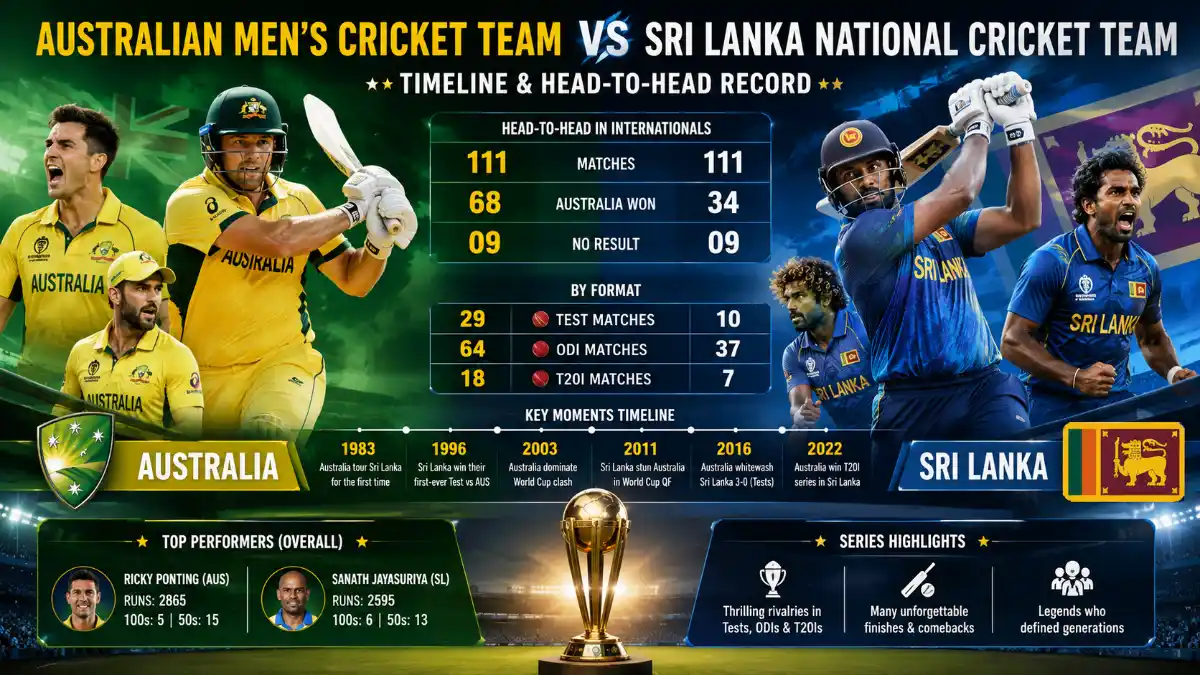
The Australian men’s cricket team vs Sri Lanka national cricket team timeline stretches back more than four decades, evolving from an unequal contest into one of the most tactically unpredictable rivalries in modern international cricket. Australia’s power-hitting, seam-heavy approach has repeatedly collided with Sri Lanka’s spin-built, patience-driven style, producing swings in dominance that make this fixture genuinely difficult to predict on subcontinent pitches.
What Does the Timeline Show?
Across Tests, ODIs, and T20Is, Australia holds the stronger overall historical record, but Sri Lanka has won the majority of recent head-to-head meetings held on Sri Lankan soil, including a statement 8-wicket win at the 2026 T20 World Cup in Kandy. This shift means that anyone searching the full Australia vs Sri Lanka cricket rivalry history needs to separate “record” from “recent form,” because the two tell very different stories.
Australia leads the all-time Test and ODI record against Sri Lanka, but Sri Lanka has won more matches played in Asian conditions since 2022, exposing a persistent tactical weakness in Australia’s batting against spin.
How the Rivalry Began in the Early 1980s
Sri Lanka’s entry into international cricket in 1982 set the stage for its earliest meetings with Australia, and the two sides quickly discovered that home conditions would dictate almost every result between them. Sri Lanka’s first notable series win over Australia came on home turf in the early 1980s, immediately establishing a pattern that would define the rivalry for the next four decades: Sri Lanka competitive or dominant at home, Australia dominant almost everywhere else.
When Did the Rivalry Start?
Australia and Sri Lanka first developed a competitive cricket rivalry in the early 1980s, shortly after Sri Lanka gained Test status, with Sri Lanka recording an early home series win that signaled its emergence as a genuine international side.
Early Growing Pains for Sri Lanka
Despite that early home win, Sri Lanka struggled badly whenever it toured Australia during this period. Sri Lanka’s batting lineup was repeatedly exposed by Australian pace bowling on fast, bouncy home pitches, a vulnerability that would take almost fifteen years to properly address. This imbalance meant that, for much of the 1980s, Australia vs Sri Lanka in Australia was rarely competitive, while matches in Sri Lanka told a completely different story.
Read More: Australian Men’s Cricket Team vs Sri Lanka National Cricket Team Timeline
The 1990s: Australia’s Golden Generation Takes Control
Australia’s rise as the dominant force in world cricket through the 1990s directly shaped the trajectory of this rivalry. With a batting order built around world-class depth and a bowling attack anchored by genuine match-winners, Australia’s tour of Sri Lanka in the mid-1990s produced results that tilted the overall head-to-head firmly in Australia’s favor for the next two decades.
Why Australia Dominated This Era
Australia’s bowling depth during this period was arguably the best in world cricket, combining pace, bounce, and control in a way few sides could match. Sri Lanka, while producing individually brilliant batters, lacked the consistent middle-order support needed to counter sustained pressure across five-day cricket, which explains why Test results tilted so heavily toward Australia during this decade.
Who Dominated the 1990s Meetings?
Australia dominated most Test and ODI meetings against Sri Lanka throughout the 1990s, largely due to superior bowling depth and batting consistency, though Sri Lanka remained competitive on slow, spin-friendly home surfaces.
2000s: Sri Lanka’s Spin Generation Levels the Contest
The emergence of a genuinely world-class Sri Lankan generation changed the shape of this rivalry permanently. Sri Lanka’s spin attack became the single biggest equalizer against Australia, particularly in ODI cricket, where slow, turning surfaces in Colombo and Kandy consistently blunted Australia’s aggressive batting approach.
The Tactical Shift Behind Sri Lanka’s Improvement
Sri Lanka’s improvement wasn’t accidental. It came from a deliberate strategy of preparing spin-friendly wickets at home and building a batting order capable of playing long, patient innings rather than chasing quick totals. This approach directly countered Australia’s preferred method of scoring quickly through the middle overs, and it remains the tactical blueprint Sri Lanka still uses today.
Why Did Sri Lanka Become More Competitive?
Sri Lanka became significantly more competitive against Australia in the 2000s by developing a world-class spin attack and preparing home pitches specifically designed to neutralize Australia’s aggressive, pace-friendly batting approach.
2010s: The Decade the Rivalry Turned Genuinely Even
This decade marked the point where Sri Lanka stopped being an occasional upset threat and became a consistent, credible contender against Australia in white-ball formats. Australia’s tour of Sri Lanka produced a T20I series loss, while home conditions in Sri Lanka repeatedly nullified Australia’s power-hitting strategy across both ODIs and T20Is.
Key Turning Point of the Decade
The most significant shift came when Sri Lanka started winning T20I series on Australian soil, not just at home. This proved that Sri Lanka’s spin-based approach could travel, at least in the shortest format, and it forced the Australian team management to rethink how they selected batting line-ups against high-quality spin bowlers.
What Changed in the 2010s?
The 2010s saw Sri Lanka begin winning T20I series both at home and in Australia, proving their spin-based tactical approach could succeed outside familiar conditions and marking a genuine shift in competitive balance.
2019 to 2022: A Rivalry Defined by Reversals
Australia’s dominant 2019 ODI World Cup campaign included a comfortable win over Sri Lanka, powered by strong top-order form. Yet barely three years later, the entire narrative flipped during Australia’s 2022 tour of Sri Lanka, where the Test series ended drawn, and Sri Lanka won the ODI leg convincingly.
Why the 2022 Tour Mattered So Much
Australia’s batting order struggled visibly against turning tracks in Colombo and Kandy during this tour, a pattern that has repeated in nearly every subsequent series played in Sri Lanka. This tour is widely regarded as the moment modern analysts began treating Australia’s vulnerability against quality spin as a structural issue rather than a one-off dip in form.
What Happened During Australia’s 2022 Tour of Sri Lanka?
Australia’s 2022 tour of Sri Lanka ended in a drawn Test series, followed by a Sri Lankan ODI series win, exposing a recurring weakness in Australia’s batting approach against spin bowling on slow, turning subcontinent pitches.
2024-25: Sri Lanka’s Home ODI Sweep
Sri Lanka delivered one of the rivalry’s biggest recent statements with a clean ODI series sweep over Australia on home soil in the 2024-25 season. This result reinforced a growing pattern: whenever Australia tours Sri Lanka, spin remains the deciding tactical factor, regardless of the personnel Australia selects.
What Was Sri Lanka’s Biggest Recent Result?
Sri Lanka’s 2024-25 home ODI series sweep over Australia stands as one of the rivalry’s most significant recent results, continuing a pattern of Australian struggles against spin bowling in Asian conditions.
February 2026: Sri Lanka’s T20 World Cup Statement Win
The most recent and most emphatic chapter of the Australia vs Sri Lanka cricket rivalry came at the 2026 T20 World Cup, played on a slow, turning surface in Kandy. Sri Lanka chased down Australia’s total of 181 with eight wickets in hand and two full overs to spare, built almost entirely around a dominant top-order batting performance.
The Batting Masterclass That Sealed the Chase
Sri Lanka’s chase never came under real pressure, largely because their opening pair built a partnership that kept the required run rate manageable throughout. One batter’s unbeaten century anchored the innings, while a composed fifty at the other end ensured Australia’s bowlers never found the rhythm needed to apply sustained pressure.
Why Australia’s Bowling Attack Struggled
Australia’s attack in this match lacked its usual pace-based firepower, with several frontline fast bowlers unavailable through injury or retirement. This forced Australia to rely on inexperienced seam options and a leg-spinner who went wicketless, a combination that struggled badly against Sri Lanka’s set batting order on a pitch offering little pace or bounce.
What Happened in the 2026 T20 World Cup Meeting?
Sri Lanka beat Australia by eight wickets at the 2026 T20 World Cup in Kandy, chasing 182 comfortably behind an unbeaten century opening partnership, exposing gaps in Australia’s depleted pace attack.
Format-Wise Head-to-Head Overview
| Format | Overall Trend | Recent Trend (2022 onward) |
| Test cricket | Australia leads comfortably | Mostly even; drawn series in 2022 |
| ODI cricket | Australia leads overall | Sri Lanka has won the more recent series |
| T20I cricket | Nearly even historically | Sri Lanka is gaining ground since 2023 |
Why Sri Lanka Keeps Troubling Australia Tactically
The recurring pattern across this Australia vs Sri Lanka head-to-head timeline points to one consistent explanation: pitch preparation. Slow, low-bounce surfaces in Colombo, Kandy, and Pallekele consistently reduce the effectiveness of Australia’s pace-and-power batting philosophy, forcing Australian batters into unfamiliar situations where patience and technique against spin matter more than aggressive stroke play.
The Structural Nature of Australia’s Spin Vulnerability
This isn’t simply about one bad series or a temporary dip in form. Australia’s domestic cricket structure produces relatively few genuine spin-bowling specialists, which means Australian batters get comparatively little exposure to high-quality spin in training and domestic competition compared to their Sri Lankan counterparts. This structural gap explains why the issue resurfaces almost every time Australia tours Asia, regardless of which players are selected.
Why Does Australia Struggle Against Sri Lanka in Asia?
Australia struggles against Sri Lanka in Asian conditions primarily because slow, spin-friendly pitches neutralize their pace-based batting approach, compounded by limited domestic exposure to elite spin bowling.
Players Who Have Defined This Rivalry
Great cricket rivalries are ultimately remembered through the players who shaped them, and this fixture is no exception. Australia’s golden generation contributed some of the format’s most destructive batters and match-winning bowlers, while Sri Lanka’s own golden generation produced a wicketkeeper-batter regarded as one of the greatest of his era and a spin bowler whose influence reshaped how Sri Lanka approached this fixture entirely.
The Modern Generation Taking Over
A new generation of Sri Lankan batters has now stepped into this rivalry’s spotlight, headlined by the centurion from the 2026 T20 World Cup meeting in Kandy. His innings is already being discussed as one of the most complete batting performances by any Sri Lankan against Australia in T20 World Cup history, and it signals that Sri Lanka’s next generation is fully capable of continuing this recent run of tactical success.
Which Players Have Shaped This Rivalry Most?
This rivalry has been shaped by generational talents on both sides, with Australia’s golden-era batters and bowlers historically dominant, while Sri Lanka’s spin legends and current top-order batters have driven the recent shift in competitive balance.
What This Timeline Means Going Forward
The trajectory of the Australian men’s cricket team vs Sri Lanka national cricket team timeline suggests the competitive gap will likely remain narrow in white-ball cricket, particularly whenever matches are played on subcontinent surfaces. Australia’s continued reliance on power-hitting without sufficient spin-playing depth remains the single biggest risk factor heading into future series and ICC tournaments.
What to Watch in Future Meetings
Future encounters played in Sri Lanka should be treated as genuine coin-toss contests, not routine Australian victories, given the consistency of Sri Lanka’s recent results in home conditions. Conversely, matches played in Australia still tend to favor the home side, meaning venue and conditions remain the single most reliable predictor of results in this fixture.
What Should Fans Expect From Future Australia vs Sri Lanka Matches?
Future Australia vs Sri Lanka matches played in Asian conditions should be considered closely contested, given Sri Lanka’s consistent recent record, while matches hosted in Australia still generally favor the home side.
Frequently Asked Questions
Who leads the Australia vs Sri Lanka head-to-head overall?
Australia leads the overall historical head-to-head across Test and ODI cricket, though Sri Lanka has narrowed the gap significantly in T20Is and recent series.
When did Australia and Sri Lanka first play each other?
The rivalry began in the early 1980s, shortly after Sri Lanka achieved Test status, with an early home series win for Sri Lanka.
Why does Sri Lanka perform so well against Australia at home?
Slow, spin-friendly pitches in Colombo, Kandy, and Pallekele reduce Australia’s pace advantage and give Sri Lanka’s spin bowlers control over the middle overs.
What happened in the most recent Australia vs Sri Lanka match?
Sri Lanka won by eight wickets at the 2026 T20 World Cup in Kandy, chasing down Australia’s total comfortably behind a dominant top-order batting performance.
Has Sri Lanka ever won a series in Australia?
Yes, Sri Lanka has won a T20I series on Australian soil during the 2010s, proving their tactical approach could succeed outside home conditions.
Why does Australia struggle against spin bowling in Asia?
Australia’s domestic cricket system produces fewer specialist spin bowlers, giving batters less regular exposure to high-quality spin compared to Sri Lankan players.
What was Australia’s biggest weakness in the 2026 T20 World Cup meeting?
Australia’s bowling attack lacked experienced pace options due to injuries and retirements, forcing reliance on inexperienced seamers and an underperforming leg-spinner.
Did Australia dominate the early years of this rivalry?
Australia dominated most matches played on Australian soil during the 1980s and 1990s, while Sri Lanka remained competitive primarily at home.
How has the rivalry changed since 2022?
Since 2022, Sri Lanka has won more meaningful series against Australia, particularly in ODI and T20I cricket played in Asian conditions.
What should fans expect from the future Australia vs Sri Lanka series?
Matches played in Sri Lanka should be treated as closely contested, while matches in Australia still generally favor the home side due to conditions.