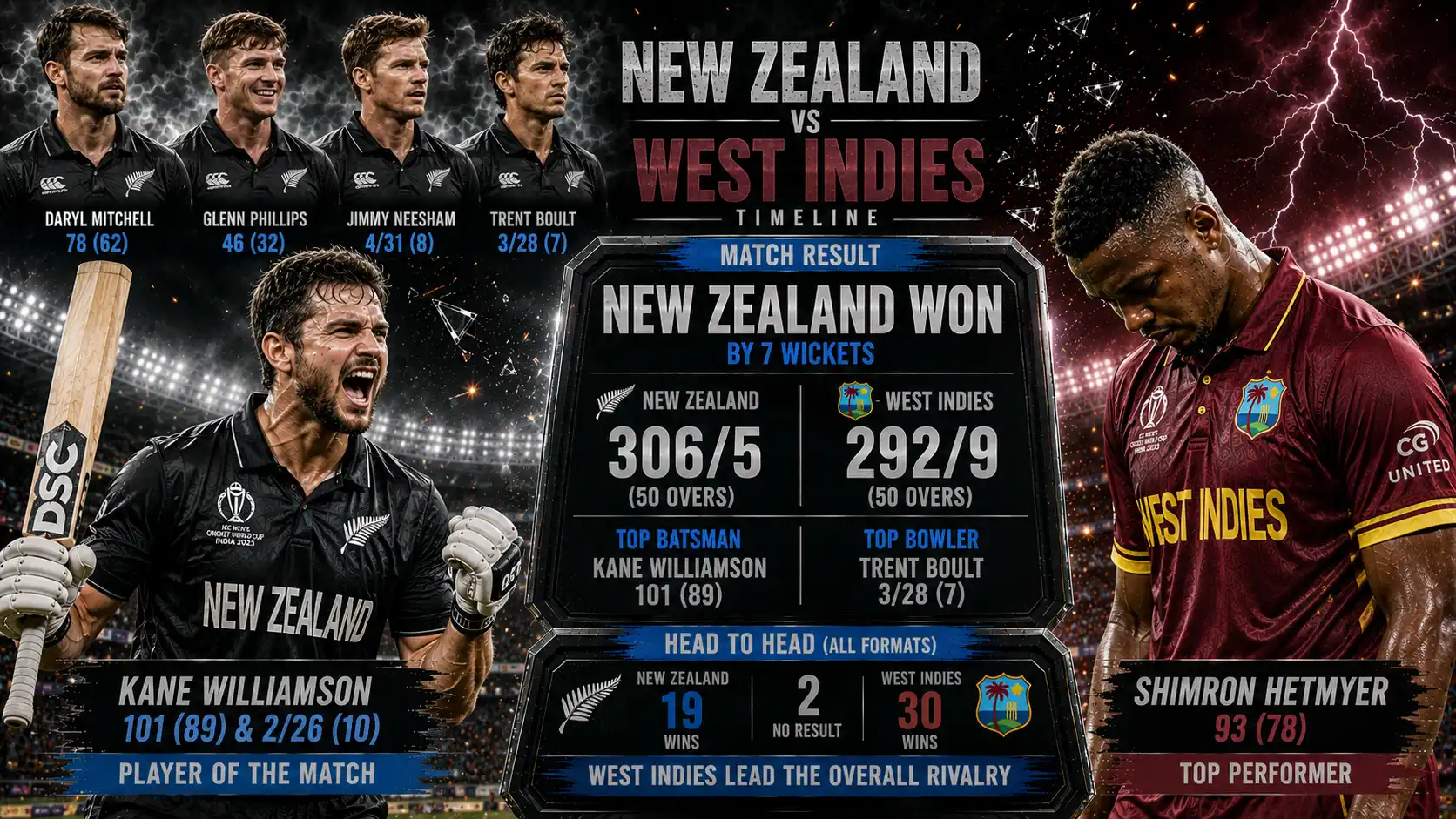
New Zealand National Cricket Team vs West Indies Cricket Team Timeline: Quick Answer
New Zealand won the New Zealand national cricket team vs West Indies cricket team timeline series 3-1 after five ODIs played between July 11 and July 21, 2026, across Guyana and Barbados. West Indies took the opening match by seven wickets.
New Zealand replied with three consecutive victories, sealing the series with a nerve-shredding one-wicket win in the fourth ODI at Bridgetown. The result carries weight beyond bragging rights – it directly touches West Indies’ hopes of clawing back ODI ranking points ahead of 2027 World Cup qualification, while New Zealand treat the tour as a live audition for players fighting for spots in a squad still missing several first-choice names.
This piece breaks down the full New Zealand national cricket team vs West Indies cricket team timeline, match by match, along with the tactical shifts, key performers, and historical rivalry context that most match reports skip entirely.
Setting the Stage for the 2026 Series
West Indies confirmed the five-ODI schedule in May 2026, splitting the series between Guyana’s Providence Stadium and Barbados’s Kensington Oval. Cricket West Indies (CWI) had already lined up a packed home season for 2026, hosting Sri Lanka, New Zealand, and Pakistan in quick succession, but the New Zealand leg stood out for one simple reason – it was strictly white-ball, with no Test component attached.
The itinerary placed the first three matches at Providence Stadium between July 11 and 16, before both sides flew to Barbados for the fourth and fifth ODIs on July 19 and 21. That geographic split mattered tactically. Guyana’s tracks tend to offer more for the spinners as the game wears on, while Kensington Oval in Bridgetown is historically a two-paced surface that rewards disciplined seam bowling in the middle overs – a detail that shaped several individual results across the series.
Squad Selection Told Its Own Story
New Zealand fielded a heavily rotated squad, resting several first-choice players ahead of long-term 2027 World Cup planning. Mitchell Santner captained the side in the continued absence of frontline seamers Matt Henry, Kyle Jamieson, and Will O’Rourke, while established batters Devon Conway, Rachin Ravindra, and Glenn Phillips also sat out due to a mix of rest, injury management, and Major League Cricket commitments. That opened the door for uncapped seamer Matthew Fisher and young spinner Jayden Lennox, both of whom ended up shaping the series far more than a typical fringe player usually does.
For West Indies, the squad selection reflected genuine urgency rather than experimentation. Every match against a top-tier ODI side like New Zealand carried direct implications for ranking points, and those points feed straight into the race for automatic qualification at the 2027 ICC Men’s Cricket World Cup. That context is why West Indies’ middle-order struggles later in the series felt less like a minor blemish and more like a genuine selection headache heading into their next assignments.
Match-by-Match Breakdown: The Full Timeline
West Indies won the series opener by seven wickets, but New Zealand responded by winning three straight matches to close it out 3-1. Here is the complete result sequence from the New Zealand national cricket team vs West Indies cricket team timeline this July.
| Match | Date | Venue | Result |
| 1st ODI | July 11, 2026 | Providence Stadium, Guyana | West Indies won by 7 wickets, chasing 268/3 in 48.5 overs |
| 2nd ODI | July 13, 2026 | Providence Stadium, Guyana | New Zealand won by 5 wickets, chasing 141/5 in 32.4 overs |
| 3rd ODI | July 16, 2026 | Providence Stadium, Guyana | New Zealand won by 6 wickets, chasing 141/4 in 39.3 overs |
| 4th ODI | July 19, 2026 | Kensington Oval, Bridgetown | New Zealand won by 1 wicket, chasing 189/9 in 44.4 overs |
| 5th ODI | July 21, 2026 | Kensington Oval, Bridgetown | In progress at Kensington Oval, Bridgetown |
Read More: New Zealand National Cricket Team vs West Indies Cricket Team Timeline
First ODI: West Indies Ride a Century-Class Chase in Guyana
West Indies chased down 268 with seven balls to spare, powered by a fluent innings from Keacy Carty that set the tone for his series. New Zealand’s total of 267 looked competitive on a Providence surface that traditionally offers an even contest between bat and ball, but West Indies’ top order refused to let the required rate build into pressure. Carty’s innings was the standout feature, and it gave the home crowd genuine reason to believe an upset series win was on the cards.
What made this result notable in hindsight is how quickly the momentum flipped. West Indies looked the sharper, more settled side in this opener, yet they would not win another match for the rest of the series – a pattern that speaks to deeper batting fragility rather than a one-off bad day.
Second ODI: New Zealand’s Bowling Depth Shows Up
New Zealand bowled West Indies out for 138 and completed the chase inside 33 overs, winning by five wickets with 104 balls unused. This was the match where New Zealand’s rotated squad started justifying selection decisions that had looked risky on paper. The reshuffled seam attack, missing three first-choice names, still managed to choke West Indies’ scoring options through the middle overs, forcing risky shots that triggered a mini-collapse.
The chase itself was comfortable rather than dramatic, but the real story was tactical – New Zealand’s captaincy decisions around field placements and bowling changes during West Indies’ innings effectively neutralized any repeat of the opener’s aggressive batting approach.
Third ODI: Jayden Lennox Delivers a Career-Best Spell
Left-arm spinner Jayden Lennox returned career-best figures of 5/19 as West Indies were bowled out for just 140, and New Zealand chased it down by six wickets. This was arguably the single most important individual performance of the entire New Zealand national cricket team vs West Indies cricket team timeline. Lennox, playing only his second overseas tour, ripped through West Indies’ middle order on a Providence pitch that offered increasing turn as the match progressed.
The collapse pattern that had briefly appeared in the second ODI became a full-blown trend here. West Indies’ batters struggled to rotate strike against controlled spin, and once one wicket fell, others followed in clusters – a tactical vulnerability that opposition analysts would have flagged heading into the Barbados leg.
Fourth ODI: A One-Wicket Thriller Seals the Series
New Zealand won by a single wicket, chasing 189 in Bridgetown to take an unassailable 3-1 series lead with one match remaining. Mark Chapman’s 80 was the standout batting effort of the innings, but the finish belonged to the tail. With New Zealand teetering, No. 11 Matthew Fisher – who had already been named player of the match in two previous games for his bowling – blunted ten deliveries in an unbeaten nine-run stand alongside Santner to somehow get his side home.
West Indies had genuine chances to win this match and level the series 2-2, but their bowlers could not finish the job on a two-paced Bridgetown surface. Akeal Hosein’s five-wicket haul kept the pressure on throughout, and Jangoo’s 51 with the bat had briefly given West Indies a target that looked defensible. The margin – just one wicket – makes this the tightest and most decisive contest of the whole series, since it turned the scoreline from a contest into a formality.
Fifth ODI: A Dead Rubber With Real Stakes
The fifth ODI at Kensington Oval carries no bearing on the series result but remains critical for West Indies’ World Cup qualification points. With New Zealand already 3-1 up, this match is technically a dead rubber in terms of the trophy, but West Indies cannot afford to treat it that way. Every ranking point matters in the ongoing race toward the 2027 World Cup, making this arguably higher-stakes for West Indies than it is for New Zealand, who are simply using the game to continue evaluating fringe players like Fisher and Lennox.
Key Performers Across the Series
Keacy Carty finished as the leading run-scorer in the series, while Jayden Lennox and Matthew Fisher shared bowling honors for New Zealand.
- Keacy Carty (West Indies): The most consistent batter across all five matches, anchoring West Indies’ only win with a fluent innings in the series opener.
- Mark Chapman (New Zealand): Delivered the standout individual batting performance of the series with 80 in the fourth ODI chase.
- Jayden Lennox (New Zealand): Recorded the best bowling figures of the series at 5/19 in the third ODI, a career-best spell that swung momentum decisively.
- Matthew Fisher (New Zealand): Uncapped heading into the tour, Fisher earned player-of-the-match honors twice for his bowling and then contributed with the bat in the series-sealing win.
- Akeal Hosein (West Indies): Took five wickets in the fourth ODI, one of the few West Indies bowlers to consistently trouble New Zealand’s batting order.
Historical Head-to-Head: A Rivalry That Rarely Stays One-Sided
New Zealand and West Indies have contested one of cricket’s most evenly balanced ODI rivalries, with results swinging sharply within individual series despite a near-level record. Across ODIs, the two sides sit almost dead even historically, and that balance is exactly why a 3-1 scoreline can feel decisive in the moment while barely shifting the long-term picture. New Zealand’s superior seam and spin depth in this series echoes a broader trend seen in their most recent home series against West Indies in 2025-26, which New Zealand also won comfortably.
In Test cricket, New Zealand’s recent form against West Indies has been considerably more dominant, including a nine-wicket win in Wellington driven by a five-wicket haul from Jacob Duffy in just his third Test appearance. That result meant New Zealand could not lose the 2025-27 World Test Championship series against West Indies, continuing a broader pattern of New Zealand asserting control in multi-format contests between the two nations over the past year.
Why This Series Fits the Bigger Picture
Both teams are treating bilateral cricket differently in 2026 – New Zealand as squad-building for a World Cup, West Indies as a ranking-points necessity. That difference in motivation explains a lot about how the series unfolded. New Zealand could afford to lose the opener and experiment with team composition because the bigger prize is 2027 preparation. West Indies, by contrast, needed wins now, and their inability to convert an early series lead into anything more reflects the pressure of playing must-win cricket against a side that wasn’t playing that way.
Tactical Threads Worth Watching
West Indies’ middle-order collapses were the single biggest tactical failure of the series, repeating across at least three of the five matches. Whether facing spin in Guyana or seam on Bridgetown’s two-paced strip, West Indies’ batting order struggled to absorb pressure once early wickets fell, a pattern New Zealand’s captaincy exploited by attacking stumps and cutting off boundary options rather than bowling defensively.
On the other side, New Zealand’s depth bowling – built around fringe names like Fisher and Lennox rather than established stars – turned out to be the series’ quiet success story. Losing three senior seamers to rest or injury management would typically weaken most sides significantly, yet New Zealand’s replacements delivered match-defining performances in back-to-back matches, suggesting genuine depth beyond the first-choice XI.
What the Result Means Going Forward
New Zealand’s 3-1 series win gives them valuable data and match fitness ahead of 2027 World Cup planning, while West Indies face renewed scrutiny over their top-order and middle-order batting depth. For New Zealand, the series validated decisions to blood uncapped players in real match pressure rather than reserve them purely for training environments – both Fisher and Lennox now enter selection conversations with genuine international credibility rather than potential alone.
For West Indies, the loss adds urgency to their qualification push, and the fifth ODI becomes something of a psychological test – can they respond to a lost series with a statement win, or does the pattern of collapse continue even in a match with no series pressure attached? Either way, this New Zealand national cricket team vs West Indies cricket team timeline offers a clear tactical lesson: depth bowling and composure under chase pressure decided this series far more than star power did.
Frequently Asked Questions
Who won the New Zealand vs West Indies 2026 ODI series?
New Zealand won the five-match series 3-1, sealing the result with a one-wicket win in the fourth ODI at Kensington Oval, Bridgetown.
How many matches were played in this series?
The series featured five ODIs – three at Providence Stadium in Guyana and two at Kensington Oval in Barbados – played between July 11 and July 21, 2026.
Which team won the first match of the series?
West Indies won the opening ODI by seven wickets, chasing down 268 with seven balls remaining in Guyana.
Who was the leading run-scorer in the series?
West Indies batter Keacy Carty was the standout run-scorer, anchoring his side’s only win with a top score close to a century.
Who took the best bowling figures in the series?
New Zealand spinner Jayden Lennox recorded the series’ best figures with 5/19 in the third ODI, a career-best performance.
Why did New Zealand rest so many senior players for this tour?
New Zealand rotated several first-choice players, including seamers and top-order batters, to manage workload and give fringe players match exposure ahead of 2027 World Cup planning.
What is at stake for West Indies beyond the series result?
West Indies need strong results and ranking points from this series to strengthen their case for automatic qualification to the 2027 ICC Men’s Cricket World Cup.
How close was the fourth ODI that sealed the series?
New Zealand won by just one wicket while chasing 189, with the last-wicket pair batting out the final overs to complete a nerve-wracking victory.
Does the fifth ODI still matter with the series already decided?
Yes – while the series result is settled, the fifth ODI still affects ODI ranking points, which matter significantly for West Indies’ World Cup qualification hopes.
What was West Indies’ main tactical weakness in this series?
Repeated middle-order collapses were West Indies’ biggest issue, with the batting order struggling to rebuild after early wickets against both spin and seam bowling.